Study Desk Height by Age and Home Office Desk Sizes
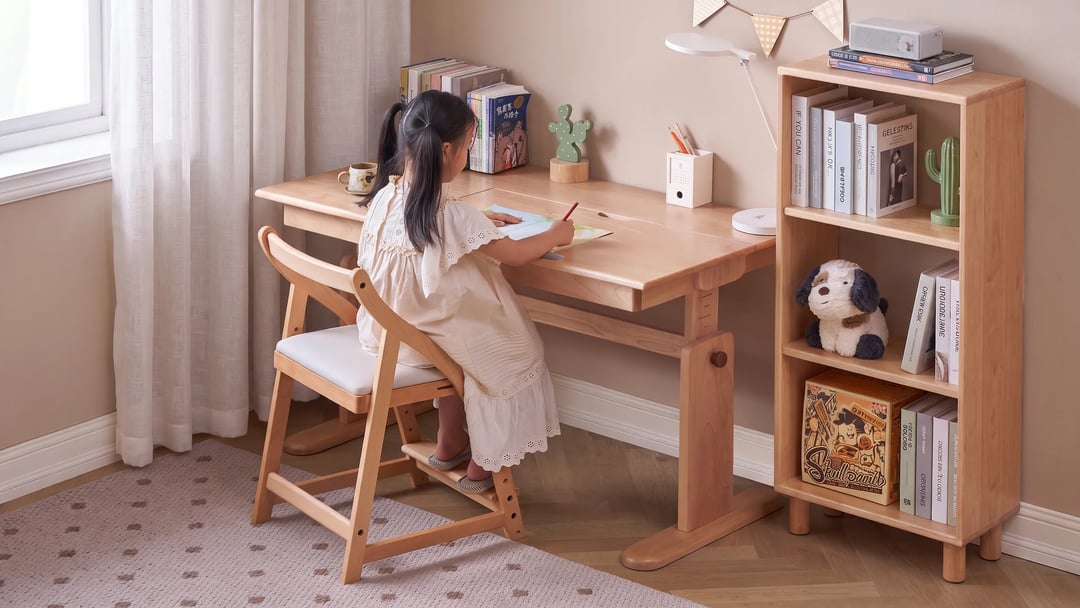
Most parents shopping for a child's study desk in Tirana choose it by eye: the bigger the better, and "about kitchen table height", because that is where homework gets done today. Then the child sits down, the shoulders climb towards the ears, the feet dangle, and half an hour later the reading happens with the head down over the notebook. The adult working from home at a 75 cm dining table gets the same result: the table is not wrong in itself, it is wrong for that body and that chair.
In our workshop we build study desks for children, office desks for companies and work corners for apartments, and every order starts with one measurement: the elbow height of the person who will sit there. This guide gives the numbers in order: the European size table for children by height, the office desk height for adults, depth and width by screen size, the space under the desk, and the order in which to set everything up. Everything is in centimetres and agrees with our guide to standard furniture dimensions.
Why a 75 cm desk does not fit everyone
The fixed office desk, anywhere in the world, is 71 to 76 cm high. The European standard for work desks, EN 527-1, puts the fixed desk at 74 cm, plus or minus 2 cm, and the British workplace guidance says that a 74 cm desk accommodates 95 per cent of the population, but shorter users need a footrest. The second sentence is the one that gets forgotten. Without a footrest, a 160 cm person either raises the chair and dangles their feet, or leaves the chair low and works with raised shoulders.
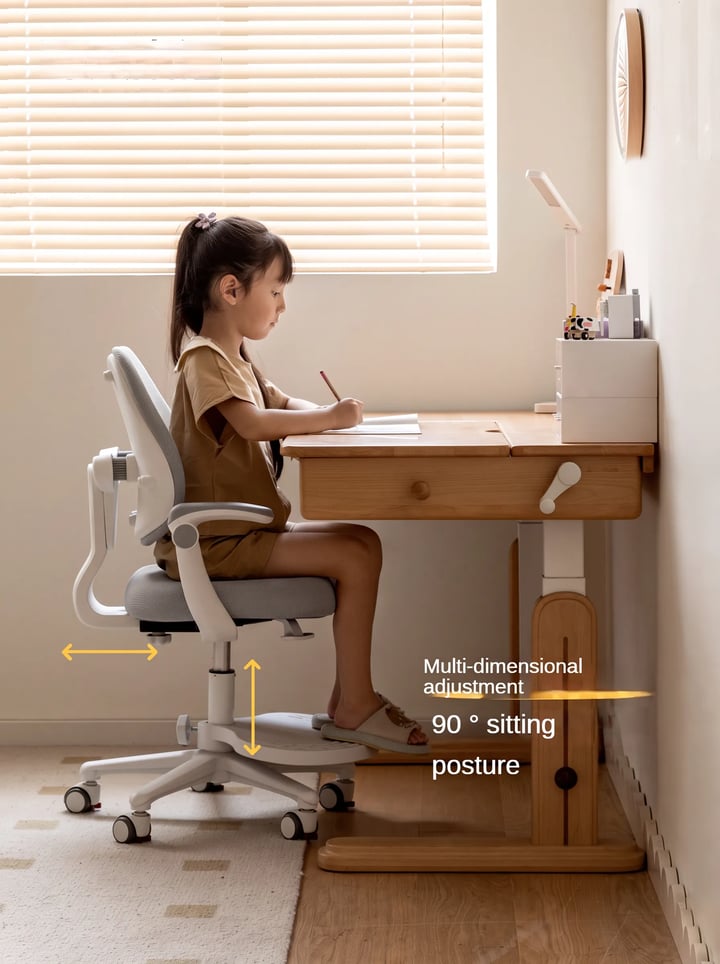
For children the gap is far bigger. A child 130 cm tall needs a desk of 59 to 64 cm; the adult desk is 10 to 15 cm above their elbow. The chair cannot fix it: the higher you raise it, the further the feet get from the floor. That is why the ergonomists' rule is the reverse of what usually happens: the chair is set to the body, and the desk is brought to the chair, not the other way round.
And "bigger" does not mean "better". A desk 45 cm deep brings the screen too close to the eyes; a desk 90 cm deep in a 10 m² child's room eats the play space and gives nothing back. Depth is chosen from the screen distance, not from the catalogue.
How the right height is measured: elbow and knee
Two measurements are enough, and both are taken with the person seated. The correct seat height is the distance from the floor to the back of the knee, with the thighs horizontal, the lower legs vertical and the feet flat on the floor. The correct desk height is the distance from the floor to the underside of the elbow, with the upper arm vertical and the forearm horizontal. These are the definitions used by the school furniture guides based on EN 1729, and they apply equally to a six year old and to a 190 cm adult.
In practice: sit the person on a height-adjustable chair, raise or lower it until the feet are flat and the knees are close to 90 degrees, then measure from the floor to the elbow hanging relaxed beside the body. That number is the height of the surface they will write on or rest the keyboard on. If the desk comes out 2 to 3 cm lower than the elbow, that is fine; higher than the elbow is not.
Study desks for children: sizes by height, not by age
School furniture in Europe is built to the EN 1729 standard, which divides chairs and tables into size marks by the pupil's height, with a colour for each. According to SATRA, part 1 of the standard, the dimensions, is in its 2015 edition, and part 2, safety, was updated in 2023 to cover kindergartens as well. The age in the table is only a guide; as one British school furniture supplier puts it, the age ranges overlap deliberately, they are a guide and not a rule.
Size mark | Child's height | Seat | Desk | Age (guide) | Colour |
|---|---|---|---|---|---|
1 | 93 to 115 cm | 26 cm | 46 cm | 3 to 4 years | orange |
2 | 108 to 121 cm | 31 cm | 53 cm | 4 to 6 years | violet |
3 | 119 to 142 cm | 35 cm | 59 cm | 6 to 8 years | yellow |
4 | 133 to 159 cm | 38 cm | 64 cm | 8 to 11 years | red |
5 | 146 to 176.5 cm | 43 cm | 71 cm | 11 to 14 years | green |
6 | 159 to 188 cm | 46 cm | 76 cm | 14 and over | blue |
7 | tall adults | 51 cm | 82 cm | adults | brown |
The heights carry a manufacturing tolerance of about 1 cm. Size 7 is listed by today's suppliers as 82 cm and by some older summaries as 83; the 51 cm seat is the same everywhere. The table is read from the height column, not the age column: an eight year old who is 145 cm tall lands in size 4 and not 3, and an eleven year old at 135 cm stays in size 4 even though their age points to 5.
The chair and the desk are chosen together
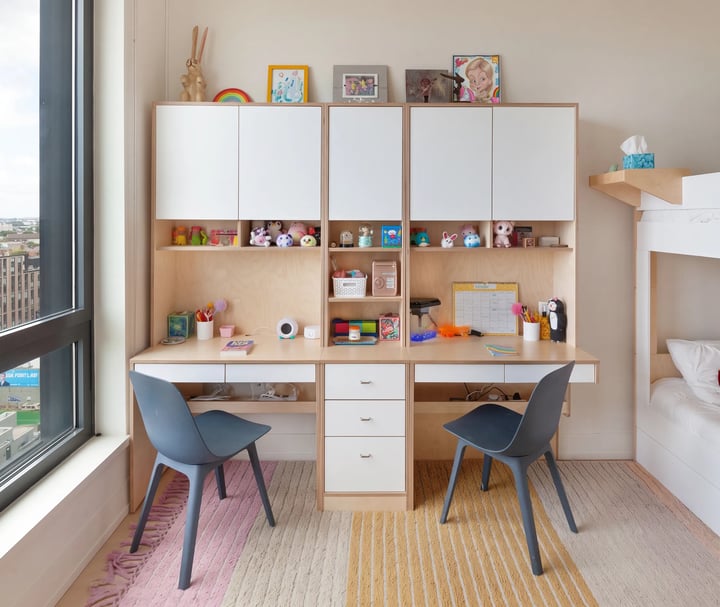
In the standard the chair and the table are a pair: size 4 with size 4, not a size 3 chair with a size 4 table. The difference between seat and surface at every size mark is 20 to 31 cm, because that is the distance from the back of the knee to the elbow at every age. When the pair is broken, the child either raises the shoulders or drops the head over the notebook, and neither shows in the first five minutes.
Two quick checks are done on the spot. Feet flat on the floor, not on tiptoe and not dangling: if they do not reach, a footrest is not optional, it is essential. And the seat depth: the child sits with their back against the backrest and two to three fingers fit between the front edge of the seat and the back of the knee. A deeper seat pushes them forward and turns the back into a curve.
Two children of the same age can need two different size marks. So we measure the child, not the age, and when two brothers share one desk we build it for the taller one and give the younger a higher chair with a footrest.
The same logic applies to schools, kindergartens and study centres: the order is placed by size mark according to the pupils' heights, not by year group. A fourth-year class with children of 130 to 150 cm needs size 4 and a few size 5, not a single height. Before new furniture is ordered, the existing tables and chairs are counted by size mark and moved between classrooms; often only one size is missing, not a whole classroom.
Adjustable or fixed, for a child who is growing
A child moves from size 2 to size 6 within ten years: from a 53 cm desk to a 76 cm one. Two solutions work. The first is the height-adjustable children's desk, which usually adjusts from about 51 to 78 cm, grows with the child and is then passed on to a brother or sister. The second is a fixed desk at today's size, with an adjustable chair and a footrest, replaced when the child moves to the next size mark.
In the workshop we build the second: a fixed study desk at the height of the size mark the child is in today, or the next one when they are at the boundary, always with an adjustable chair and a footrest. When the desk is part of the room, under a loft bed or along the window wall, the top can be replaced later without touching the shelves. Two additions extend the life of any desk: a monitor riser that sets the screen height independently of the desk, and a pull-out keyboard tray that lowers the typing surface when the desk has been left too high.
Building your child's room and not sure which size mark to choose? Get in touch and we will come back with a drawing and a free quote.
Office and home office desks: 65 to 85 cm
For adults the standard is EN 527-1. Fixed desk: 74 cm, plus or minus 2. Height-adjustable desk: 65 to 85 cm for seated work, and 65 to 125 cm for sit-stand desks. The 65 to 85 range is not a luxury. According to the American BIFMA G1 guideline, a desk should cover the range from a 152 cm woman to a 188 cm man, and in practice a 157 cm person needs a desk of about 62 cm, while a 185 cm person needs about 72 cm. The 73 cm catalogue desk fits without adjustments only people of roughly 170 to 180 cm; everyone else compensates with the chair, a footrest or their shoulders.
In the workshop this means two questions before we draw an office desk: who sits there, and on what chair. For a single person we build a fixed desk at their elbow height, sometimes 70, sometimes 76. For a desk used by several people in turn, a fixed 74 cm top with an adjustable chair and a footrest, or a height-adjustable base with a top built by us. For home offices in Tirana, where the desk often slots into a bedroom alcove, the same logic: chair first, desk after it.
For an office with ten workstations the sum is the same, only multiplied. The fixed 74 cm desk serves the middle band; for everyone else, either a footrest at every fixed desk or an adjustable base of 65 to 85 cm. When a desk is shared by several people on shifts, the wider range matters: the Dutch NPR 1813 norm, about 65 to 130 cm, is broader than the EN 527-1 minimum precisely for this. On the adjustable base we build the top, the cable trays and the dividers, as described on our custom office furniture page.
Depth and width: how much room the screen needs
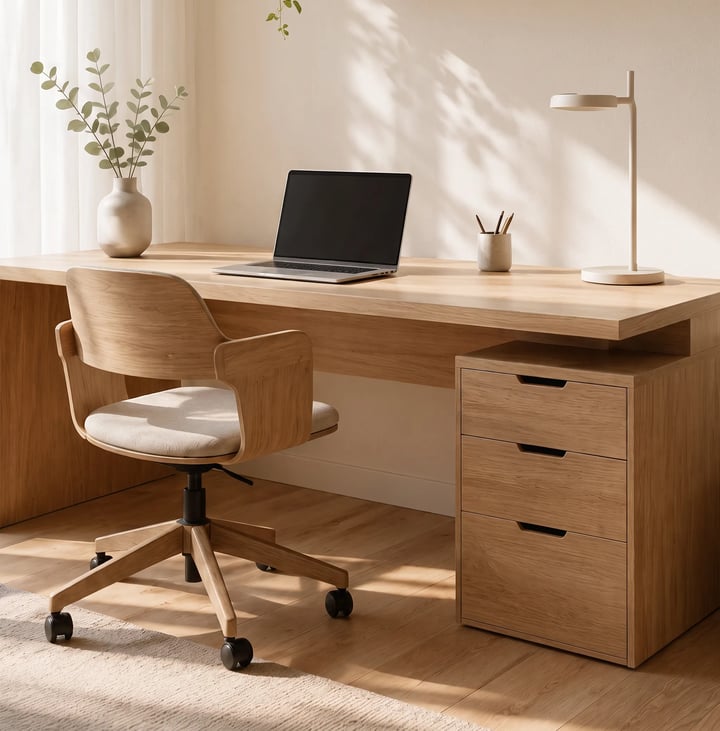
Desk depth sets the distance from the screen to the eyes, and that sets eye strain and neck posture. The British guidance gives the eye-to-screen distance as 60 cm plus or minus 15, so 45 to 75 cm depending on the screen size; OSHA in the United States says at least 50 cm and up to 100. The arm's-length rule covers both.
The depths follow from that. For a laptop or a screen up to 24 inches, 60 cm is enough. For 27 to 32 inches, 70 to 80 cm. On a shallow surface of 45 to 50 cm, which is what many old writing desks and wall-mounted desks are, a monitor arm reclaims 10 to 20 cm of distance, because the screen goes back to the wall instead of sitting on its own stand. In width: a single laptop, 100 to 120 cm; one monitor with room for a notebook, 120 to 140 cm, comfortable at 140 to 160; two monitors, 160 to 180 cm. For a child in a 10 m² room we usually build 100 to 120 cm wide by 60 cm deep, so the screen sits at arm's length without taking the room's play space.
The space under the desk and behind the chair
The numbers nobody sees are the ones that decide whether the desk gets used. According to OSHA's computer workstation guidance, the leg space under the surface should be 50 to 72 cm high and free of drawers, boxes and computer towers, so the person can change posture through the day. Its purchasing minimums are 45 cm of depth for the knees, 61 cm for the feet and 53 cm of width. The revised EN 527-1 goes further: 80 cm of depth at floor level and 85 cm of width for fixed desks.
Between the thigh and the underside of the desk you need 5 to 7 cm; that is why the centre drawer of old desks is so often the reason the chair cannot go high enough, and why the desk top together with its rail should not exceed 5 cm in thickness. Behind the desk, for the chair to slide back and the person to stand up, 60 cm is the minimum and 90 cm is comfortable; in a bedroom alcove this figure decides whether the desk fits at all, and it matches the bedroom clearances.
The order of adjustment and the mistakes we see most often
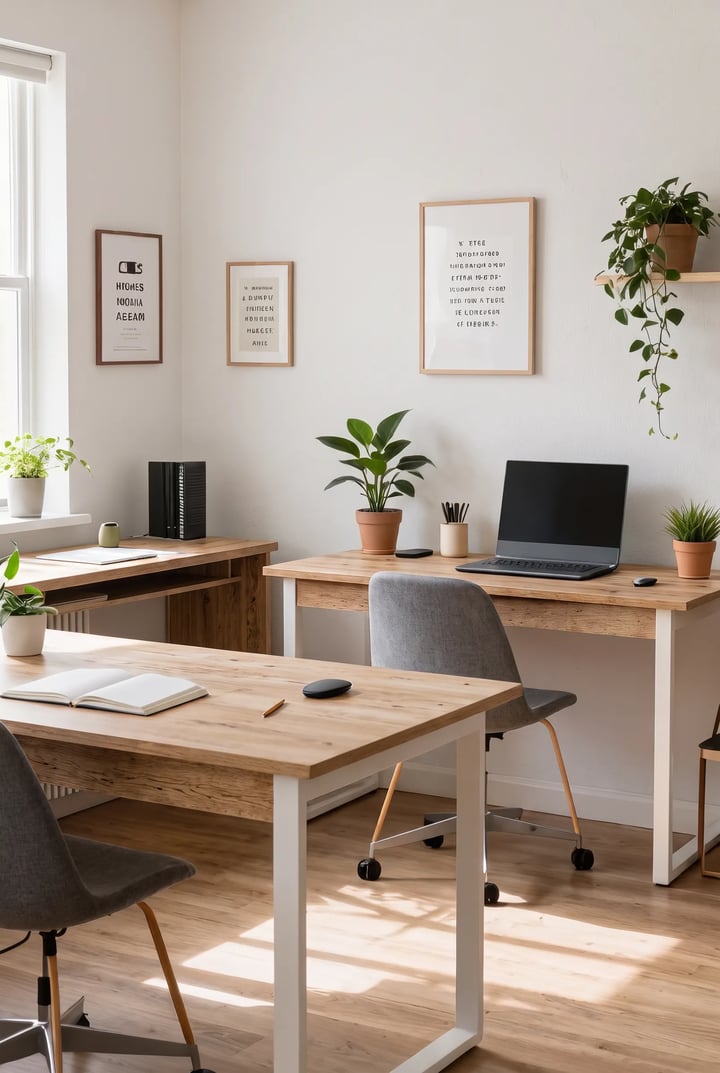
1. Chair to the body. Sit down, adjust the height until the feet are flat and the knees are close to 90 degrees, with two to three fingers of space behind the knee.
2. Desk to the elbow. The surface you write on or rest the keyboard on should be at the height of the relaxed elbow, or slightly below. OSHA says it in one sentence: elbows at about the height of the keyboard, shoulders relaxed, wrists straight.
3. When the desk is fixed. Too high: raise the chair and add a footrest, even a sturdy box or two boards. Too low: stable boards or blocks under the desk legs, as OSHA advises, not books under the keyboard.
4. The screen. Top edge of the screen at eye level or slightly below, at arm's length, straight ahead. A laptop alone on the desk forces the head down; with a stand and an external keyboard the problem disappears.
5. Keyboard and mouse. In front of the body, at the same height, not at the edge of the desk. If the desk cannot be lowered, a pull-out keyboard tray below the surface solves it.
What cannot easily be undone: a fixed desk built at the wrong height for the person, and a surface that is too shallow. The first needs a new base or a rebuild; the second is fixed only with a monitor arm. The rest, width, drawers and cable routing, gets sorted over time. And the mistakes we see most often are five.
The chair is adjusted to the desk. The person raises the chair until the elbows reach the desk, and the feet stay in the air. It is the number one mistake with children and with shorter adults, and it is solved with a footrest.
A desk 5 cm too high. It does not show in the morning, it shows in the afternoon: raised shoulders, a stiff neck, sore trapezius muscles. Five centimetres are enough.
The screen too low or too close. The head tilts forward. According to Hansraj's study in Surgical Technology International, 2014, a head tilted 15 degrees forward loads the neck with about 12 kg, and at 60 degrees with about 27 kg, instead of the 4 to 5 kg it weighs. A laptop flat on the desk is the most common cause.
Dangling feet on children. The child slides forward, curves the back and tires within ten minutes. The footrest is the cheapest fix in this whole article.
Chair and desk of different size marks. A size 3 chair from the kindergarten with a size 5 desk from a cousin. Both are "for children"; together they do not work.
Standing desks, dining tables and the alternatives
The dining table is 74 to 75 cm, so it is at office desk height, and for a week it works. The problem is the dining chair, fixed at 45 to 46 cm with no adjustment: anyone under 170 cm works with raised shoulders, and a child has no chance at all. If you use it for long, put an adjustable office chair at the dining table too; the dimensions of the table itself are in our dining table guide. The classic writing desk, 45 to 50 cm deep, is beautiful and shallow: fine with a laptop, with a monitor it brings the screen too close. The folding balcony table, 70 to 72 cm high, is a weekly solution, not a yearly one.
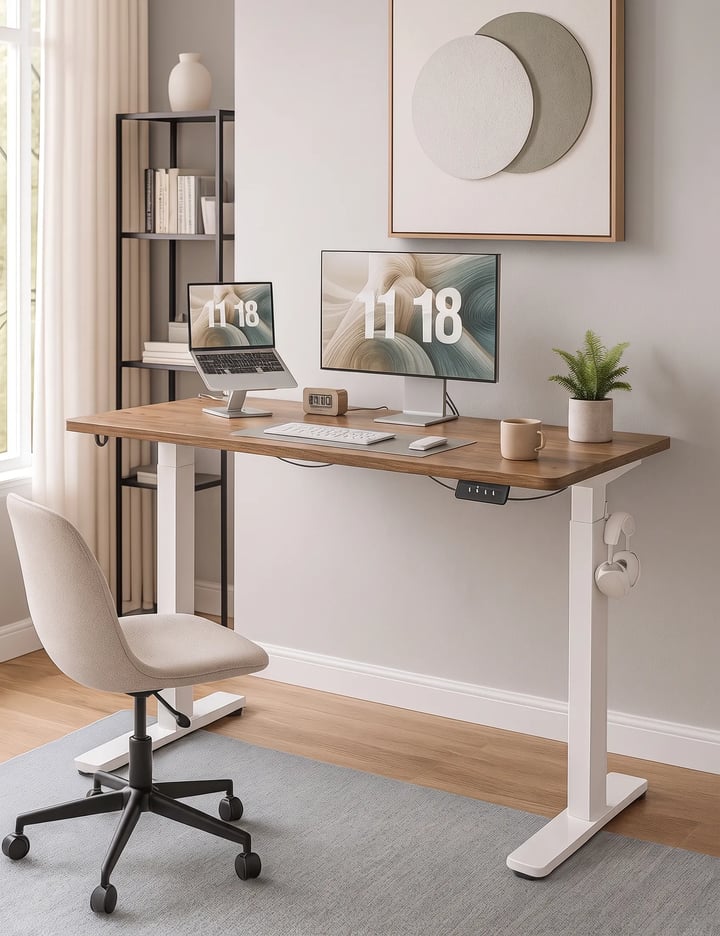
The sit-stand desk, 65 to 125 cm under EN 527-1, is worth it for anyone who spends eight hours in front of a screen, but not for the reason it is advertised. According to the meta-analysis by Saeidifard and colleagues in the European Journal of Preventive Cardiology, 2018, covering 46 studies and 1,184 participants, standing burns only 0.15 kcal per minute more than sitting: a 65 kg person who stands for six hours a day spends an extra 54 kcal. The real gain is the change of position, every 30 to 60 minutes, at a sitting-to-standing ratio of 1:1 to 2:1, because standing all day brings back pain and vein problems just as sitting all day does. For a desk like this we build the top, 70 to 80 cm deep, on a standard electric base.
Frequently asked questions
How high should the study desk be for a 7 year old?
It depends on height, not age. A seven year old of 125 cm lands in size 3: 35 cm seat, 59 cm desk. At 135 cm, size 4: 38 cm seat, 64 cm desk. Measure the child before you order.
How high should an office desk be for an adult?
At the height of the seated elbow, which for most adults comes out at 62 to 76 cm. The standard fixed desk is 74 cm and fits without adjustments only people of roughly 170 to 180 cm; shorter people need a footrest or a lower desk.
How deep should a desk be for a monitor?
60 cm for a laptop or a screen up to 24 inches, 70 to 80 cm for 27 to 32 inches, so the screen sits 45 to 75 cm from the eyes. On a shallow desk, a monitor arm reclaims 10 to 20 cm.
Is a height-adjustable kids' desk worth it?
Yes, if it will serve for ten years or for two children. Otherwise a fixed desk at today's size mark, an adjustable chair and a footrest work just as well and have nothing to break.
Do you build the study desk together with the child's room?
Yes. The desk, the shelves above it, the bed and the wardrobe are built as one whole, from your photo or idea and the measurements we take on site, with the desk at the child's size mark and not at catalogue height.
We build study desks and office desks in our Tirana workshop, in melamine, lacquered MDF or solid wood, with the height taken from the person who will sit there: for children as part of a custom kids' room, for adults as custom office furniture. The cost depends on the material, the size of the top, the drawers and shelves, and on a fixed or adjustable base; the quote is free and itemised.
If you are choosing a desk for your child or your office in Tirana, Durrës, Vlorë, Shkodër, Elbasan or Fier, get in touch and we will come back with a drawing and a free quote.
You can see finished work on our Instagram.
Want a piece like this built for you?
Get in touch and get a free price estimate, with no obligation.
Get a free quote