Nightstand Dimensions in cm: Height, Width, Models
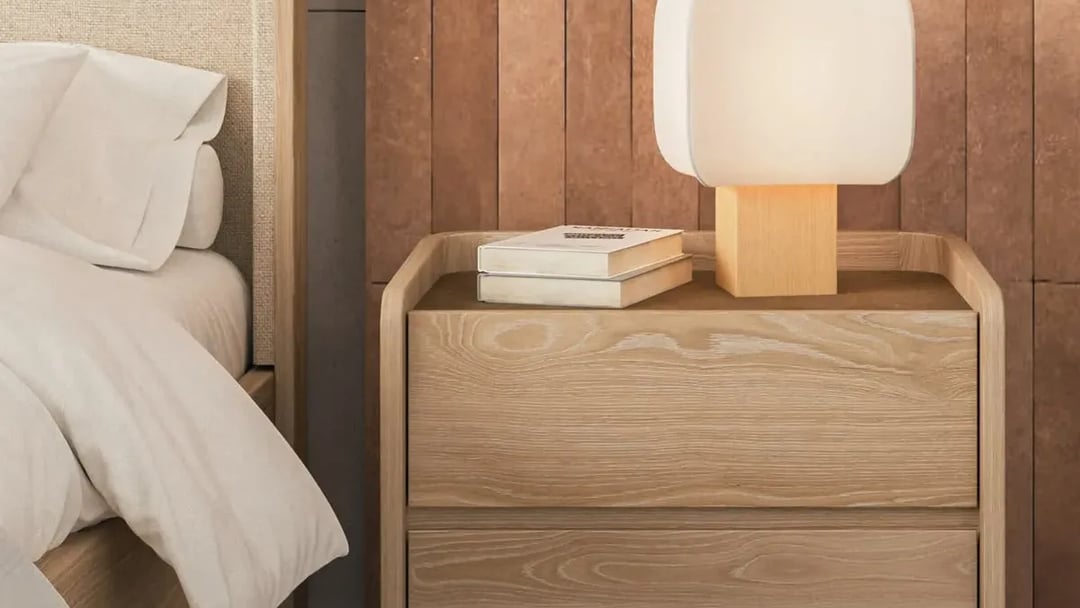
Nightstands are bought last and chosen from a photo: the bedroom set comes with two in the same colour as the wardrobe, and nobody asks how tall they are. Then the bed is assembled, the mattress goes on, and the glass of water ends up 15 cm below the hand looking for it in the dark. The nightstand was not wrong in itself; it was wrong for that bed.
In our Tirana workshop we build nightstands to order together with the bed, and every order starts from a single number: the height from the floor to the top of the made-up mattress. This guide gives the numbers that decide, in order: how tall a nightstand should be, how wide and how deep, how far from the bed, which model suits which room, and where it most often goes wrong. Everything is in centimetres and matches our guide to standard furniture measurements.
One word on terms. English uses nightstand, bedside table, night table and bedside cabinet for the same piece; Albanian has one word, komodinë, and a separate one, komo, for the chest of drawers. This guide is about the small piece beside the bed.
How tall should a nightstand be: the mattress rule
There is no standard nightstand height that suits every bed. The working rule is a single one: the top of the nightstand sits level with the top of the mattress, or slightly above it. From the bed you reach up more easily than down, so 2 to 5 cm above the mattress is fine, while below the mattress top is almost never right. The British bed maker Feather & Black says the same, align with the mattress top or sit 2 to 5 cm above it, and Costco's buying guide puts the limit at level with the mattress or within about 5 cm of it.
The tolerance varies by source, and it is worth knowing. Some American guides, Chairish among them, widen the band to 5 cm below to 15 cm above the mattress top; European guides and MebelTops keep it at plus or minus 5 cm. Everyone agrees on two things: aim for the mattress top, and do not go below it.
That is why catalogue "standard heights" mislead. In Europe nightstands are usually sold 55 to 65 cm tall; in the United States 61 to 71 cm. But today's mattresses are thicker than they were: according to Mattress Nut, memory foam and hybrid mattresses alone reach 30 to 36 cm, and on a box spring and frame the bed top sits 71 to 81 cm up, where a 63 cm nightstand ends 8 to 18 cm below it. In Albania the opposite happens: many catalogue nightstands are 42 to 45 cm tall, built for low beds, and end up next to a wooden frame whose mattress tops out at 55 to 60 cm.
How to measure: floor to mattress top
1. Assemble the bed and make it up. Measure the finished bed, not the frame and not the mattress in the shop. If you use a thick mattress protector or a topper, include it, because it adds real height; SICOTAS puts it plainly: measure from the floor to the top of the mattress, not the frame, toppers included.
2. Measure from the floor to the mattress top. That number is the target nightstand height. Write it down: it is the number you give the workshop, or the one you compare every model in the shop against.
3. Add up to 5 cm, no more, and never subtract. For a mattress topping out at 58 cm, the right nightstand is 58 to 63 cm.
4. Check the space beside the bed. The gap from the frame, the walkway and the drawer opening are covered below; they decide the width and the depth.
5. Choose the model last. Drawer, open shelf or wall-mounted: that choice comes after the height and the space are clear, not before.
Two things cannot be fixed later: the position of a wall-mounted nightstand, which needs fresh drilling to move, and the cable hole at the back, which is drawn before the nightstand is built.
Nightstand dimensions: height, width, depth
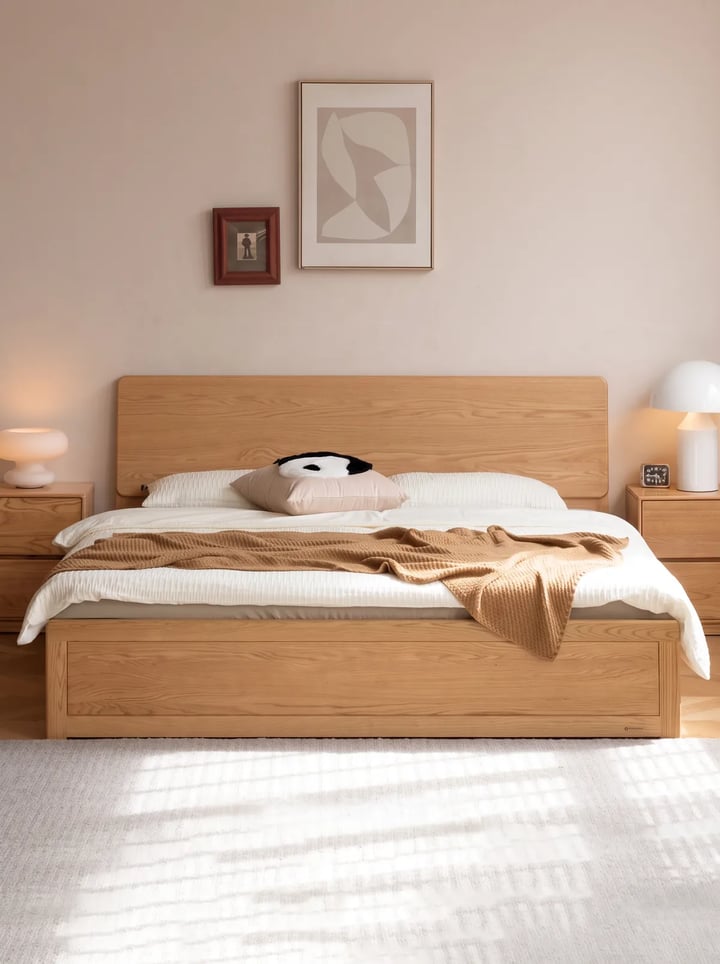
The mattress sets the height. The bed and the room set the width and the depth. For a 140 or 160 cm bed, a width of 40 to 55 cm holds the lamp, the phone, the glass and a book without crowding. For a single bed or a room with only 60 cm beside the bed, small nightstands of 30 to 40 cm are the right answer. For a 180 cm bed, a 55 to 60 cm nightstand keeps the proportion; a 35 cm one next to a king bed looks like a stool.
Depth follows the room. 35 to 45 cm is the usual band: enough for a lamp base and the night things. In small rooms keep it to 30 to 35 cm. Beyond 50 cm deep a nightstand starts to block the way into the bed, especially where the frame projects past the mattress, as MebelTops notes in its list of mistakes.
Bed and mattress | Nightstand height | Width | Depth |
|---|---|---|---|
Low platform bed, mattress top 45 to 50 cm | 45 to 55 cm | 40 to 50 cm | 35 to 40 cm |
Wooden frame, mattress top 55 to 60 cm | 55 to 65 cm | 40 to 55 cm | 35 to 45 cm |
Upholstered bed with a thick mattress, top 65 to 75 cm | 65 to 80 cm | 45 to 60 cm | 35 to 45 cm |
90 cm single bed or a small room | to the mattress | 30 to 40 cm | 30 to 35 cm |
180 cm bed in a wide room | to the mattress | 55 to 60 cm | 40 to 45 cm |
The third row is the one that gets forgotten: upholstered beds with a padded base and a 30 cm mattress top out at 70 cm or more, and need nightstands that sets do not include. Feather & Black notes that for beds with deep mattresses the nightstand goes up to 75 or 80 cm. For the bed sizes themselves and how much the frame adds, we have a separate guide.
How far from the bed, and how much room around it
The nightstand does not sit tight against the frame. Leave 5 to 10 cm between the frame and the nightstand, so the sheets and duvet can hang without pushing it; Costco's guide advises at least about 10 cm for the same reason. Beyond 15 cm the nightstand moves out of reach.
After the nightstand comes the walkway. Beside the bed you need 60 cm minimum to pass and 70 to 75 cm to be comfortable, measured from the frame to the wall or wardrobe, as we set out in wardrobe and bedroom dimensions in cm. The nightstand sits inside that space, not in addition to it: a 60 cm walkway with a 45 cm deep nightstand leaves 15 cm to pass beside it. That is why in small rooms the nightstand gets shallow or goes on the wall.
The drawer has its own need: 50 to 60 cm in front of the nightstand to open fully, and a check that the drawer front does not catch on the bed frame when it opens. On upholstered beds, where the frame projects 10 to 15 cm past the mattress, this is the most common reason a nightstand drawer only opens halfway.
Building your bedroom and not sure what height to give the nightstands? Get in touch and we will come back with a drawing and a free quote.
Drawer, open shelf or nothing at all
A drawer hides; an open shelf shows. For the night things, medication, the charger and the book you do not want to see by day, a nightstand with drawers is the safe choice, and open shelves next to a bed fill with clutter within two weeks, as we said in modern bedroom design. The open shelf has one advantage: the book goes down in one movement without opening anything, so the best combination is a drawer above and an open space below.
When there are two drawers, keep them shallow. Two drawers 10 to 12 cm deep work better than one at 25 cm, because a deep drawer becomes a box where everything sinks to the bottom; MebelTops lists this among the main mistakes. Soft-close runners are not a luxury beside a bed: they are the difference between a drawer that opens at three in the morning without waking the other person and one that does.
There is also a historical reason nightstands have drawers rather than doors. According to Laurel Crown, the nightstand began as the commode, a small cabinet with doors that hid the chamber pot before plumbing came indoors; when the need disappeared, doors gave way to drawers and the piece stayed. So today the nightstand is a drawer, and the dresser, the large chest with four or five drawers or the mirrored vanity, is a different piece and should not be confused with it.
Nightstand models and where each one belongs
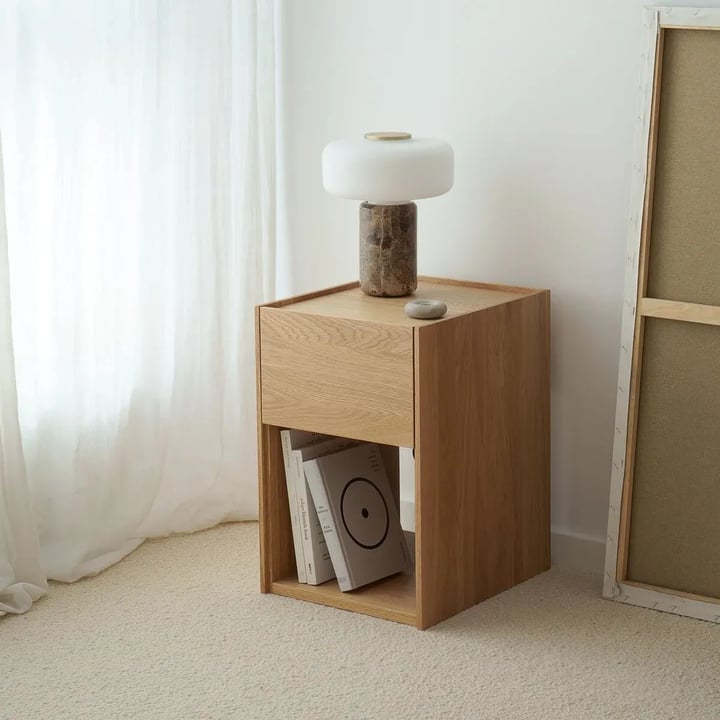
Freestanding nightstand with drawers. The classic model, on the floor, with one or two drawers. It holds the most, moves with you when you change the bed and can be built to any height. For most bedrooms in Tirana it is the right choice, and we build it in the same material as the bed or the wardrobe.
Floating nightstand. No legs, fixed to the wall at the exact mattress height. According to mybettershelf, it frees the floor, cleans underneath and can be set precisely to the bed height; in exchange it holds less and cannot be moved without drilling the wall again. It needs a wall that carries the load, or a timber panel behind the bed to fix into.
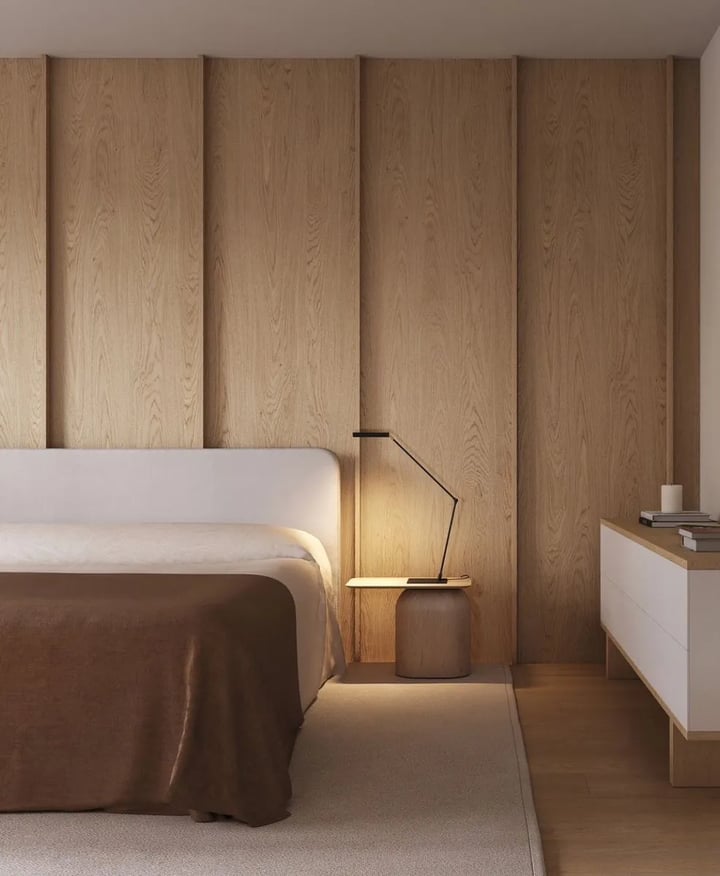
Shelf integrated into the headboard. When the headboard becomes a timber panel the width of the wall, the nightstand becomes a shelf projecting from the panel itself, at mattress height. It is the cleanest solution for Japandi and minimalist rooms, as we show in Japandi interior design, and the only one that guarantees the height, because the shelf and the bed are drawn together.
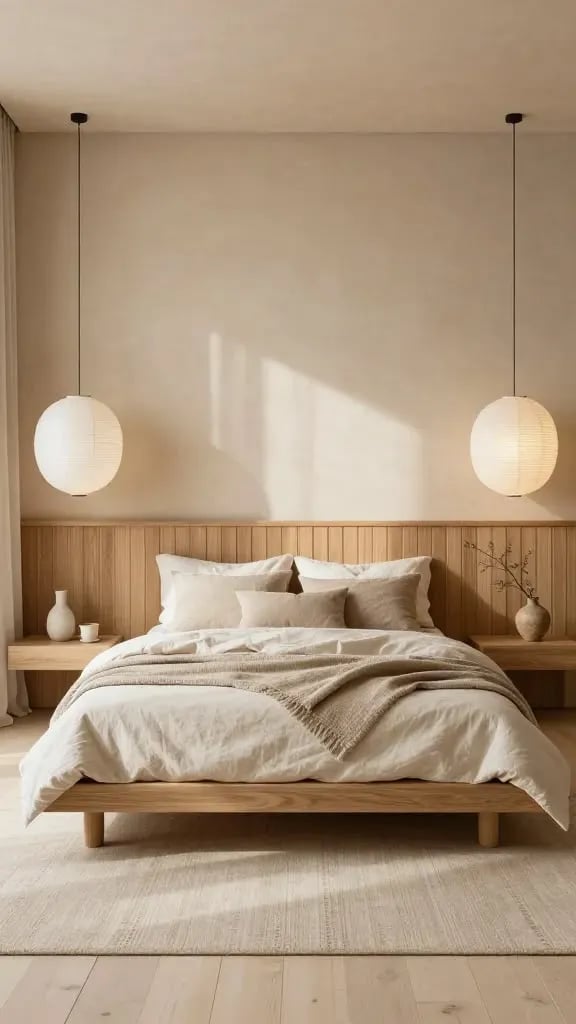
Table or stool beside the bed. No drawer, just a surface. The smallest visual weight of all, good for narrow rooms and for anyone who wants only the lamp and the glass. Its limit is that everything stays on show.
Do nightstands have to match
No. Two identical nightstands are a preference, not a rule, and a full set of five pieces in one colour makes a room look like a showroom. What must match is the height: two nightstands at different heights beside the same mattress are a functional mistake, not a stylistic one. After the height, one shared element is enough, the wood tone, the profile or the visual weight, as SICOTAS sums it up: they do not have to be identical, but they should align in height, scale and finish.
That opens a practical option sets do not offer: a nightstand with drawers on the side of the person who reads and keeps medication, and a floating shelf on the wall side where the walkway is 55 cm. Both in the same oak, at the same height, and the room looks considered rather than bought.
Small nightstands for small bedrooms
In older Tirana apartments the bedroom is often 10 to 12 m², with a 160 cm bed and a wardrobe taking the whole wall. Small nightstands, 30 to 40 cm wide and 30 to 35 cm deep, are the rule there, not the exception. When even that does not fit, a floating nightstand or a shallow 20 to 25 cm shelf above the headboard holds the lamp and the phone without taking a centimetre of floor.
Do not split the space evenly when there is not enough of it: better one protected walkway of 70 to 75 cm on the side you get into bed from, and 45 to 50 cm on the wall side with a floating shelf, than 60 cm on both sides with two nightstands in the way.
And when the bed came out too tall after a new mattress, the old nightstand is not thrown away straight off. Feet or a plinth underneath, a new top, or a taller lamp bring it back to level; in the workshop we often make an 8 to 10 cm plinth in the same material.
The lamp, the sockets and the cables
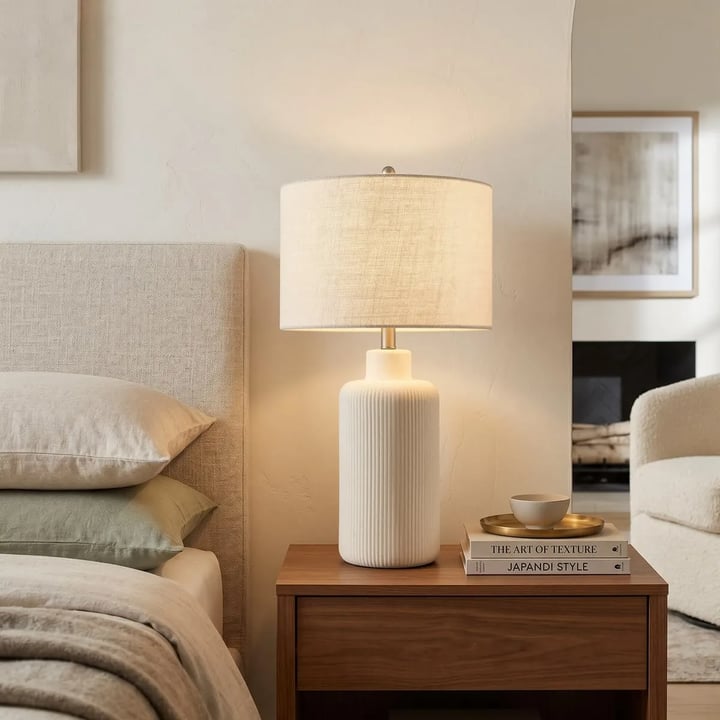
The lamp is chosen after the nightstand, because it is tied to its height. Chairish's rule: the bottom of the shade sits at eye level or just below it when you sit up in bed, the lamp is 5 to 8 cm taller than the nightstand itself, and from the floor to the top of the lamp comes to about 147 to 163 cm in total. Taller than the headboard it should not be. If the lamp shines into your eyes it is too low; if you read with your head down to find the light it is too high.
Pendants and wall lights free the nightstand surface completely, and in small rooms that is a real advantage: a 35 cm nightstand with no lamp on it holds everything else.
Sockets go in before the wall closes, at nightstand height, not behind the bed where they cannot be reached, as we said in modern bedroom design. In the nightstand itself we build a cable hole at the back or a cut-out in the top, so the phone cable does not hang over the drawer front. That is drawn before the build; afterwards it can only be added with a hole that shows.
The mistakes we see most often
Nightstand too low after a new mattress. The old 18 cm mattress is replaced by a 28 cm one, or a topper is added, and the nightstand that was level ends 10 cm below. It is the most common mistake and the easiest to foresee: measure the mattress you will have, not the one you have.
Too deep for the room. A 50 cm deep nightstand in a 60 cm walkway is an obstacle every night. Choose the depth from the walkway, not from the photo.
One deep drawer instead of two shallow ones. Within two months it is a jumbled box. Two drawers of 10 to 12 cm separate the charger from the books.
The wrong lamp. Too tall lights the room rather than the book; too low glares. Bottom of the shade at seated eye level.
No room for cables. The phone cable draped over the drawer front. The cable hole is drawn before the build.
The drawer catches the bed frame. Especially on upholstered beds. Check against the real frame, not the mattress size.
Frequently asked questions
How tall should a nightstand be?
Level with the top of the made-up mattress, or up to 5 cm above it. For most wooden-frame beds that comes to 55 to 65 cm; for low platform beds 45 to 55 cm; for upholstered beds with a thick mattress 65 to 80 cm. Measure your bed, not the catalogue.
How far should a nightstand be from the bed?
5 to 10 cm from the frame, so the sheets do not catch and the hand reaches it. Beside the bed, nightstand included, you need 60 cm minimum to pass and 70 to 75 cm to be comfortable.
Nightstand with a drawer or without?
With a drawer, in almost every case: it hides the night things and keeps the room tidy. Without one only when the room is very narrow or when you want a visually light stool and keep only the lamp and the glass on it.
How tall should the nightstand be for a child's bed?
The same rule, by the child's mattress: children's beds often top out at 35 to 50 cm, so the nightstand is 35 to 50 cm, lower than the parents'. For a loft bed or bunk bed, a floating shelf at mattress height replaces the nightstand; the types are in children's bed types by age.
Do you build nightstands for hotels?
Yes. For hotel rooms the nightstand is built identical for both sides of the bed, often wall-mounted so the floor cleans faster, with an integrated socket and USB and drawer runners rated for daily use. The details are on hotel furniture.
We build nightstands in our Tirana workshop together with custom beds, in oak, walnut, lacquered MDF or melamine, at the height of your mattress and with soft-close drawers; when the whole room is ordered, the nightstands, bed and wardrobe come from the same material, as we explain on custom bedrooms. The cost depends on the material, the number of drawers, the hardware and whether the nightstand is freestanding or wall-mounted.
If you are choosing nightstands for your bedroom in Tirana, Durrës, Vlorë, Shkodër, Elbasan or Fier, get in touch and we will come back with a drawing and a free quote.
Finished work is on our Instagram.
Want a piece like this built for you?
Get in touch and get a free price estimate, with no obligation.
Get a free quote