Coffee Table Size Guide: Height, Length and Shape
Most people who come to us in Tirana for a coffee table have already chosen it by the sofa: the same colour, almost the same length, and "as high as the arm". That is where the mistakes start. The reference point for a coffee table is neither the arm nor the back of the sofa but the seat cushion. The length should not match the sofa but run half to two thirds of it. And a small living room does not need a small table; it needs a narrow one.
In our workshop we build custom coffee tables, and every order starts with three numbers taken from the client's sofa: the seat height, the length between the arms and the space left around it. This guide gives you those numbers in order, explains the shape and material that follow from them, and closes with the models people ask for most. Everything is in centimetres and agrees with our living room and dining room measurements and the room by room measurements guide.
Coffee table, cocktail table, side table: which is which
The low table in front of the sofa is the coffee table: the surface for the glass, the book and the remote, and the piece that holds the seating group together. In American usage "cocktail table" means the same thing, and the old distinction (coffee tables round or oval, cocktail tables square or rectangular) is one even manufacturers no longer agree on. A "centre table" is usually a larger, more decorative piece placed in the middle of a room rather than at the sofa. In Albanian the piece is simply "tavolina mesi", the table in the middle.
A side table is a different piece: smaller, taller, at the height of the sofa arm, and beside the sofa rather than in front of it. A nest of tables, usually two or three that step down 5 to 10 cm each and slide under one another, is the small living room's answer to needing more surface now and then. An upholstered ottoman with a tray is the soft alternative, which we come back to below.
The low form we know today is fairly recent. Isamu Noguchi's table, made by Herman Miller since 1948, is 40 cm high and is still the reference for the modern low table. The tea tables of the century before were noticeably taller; heights came down with lower sofas and with the television.
Height: measure the sofa seat, not the arm
The rule we use in the workshop is simple: the coffee table sits level with the sofa seat or up to 5 cm below it. A typical sofa seat is 43 to 48 cm off the floor, with 45 cm the standard, so most coffee tables come out at 40 to 45 cm high. Measure the cushion compressed, not plumped: sit down, stand up and measure where the cushion settles.
Higher than the seat, the table looks heavy and you lift your arm to set a glass down. More than 5 cm lower, you bend for it every time. Low lounge sofas with a 34 to 40 cm seat need an equally low table, 32 to 38 cm, and here the off-the-shelf 45 cm table is the most common mistake we see.
Designers do not entirely agree on this number. In a Livingetc article, designer Alexandra Peck explains that a table lower than the seat cushion gives the room a modern feel rooted in mid-century and Japanese design, while the article concludes that ideally the two are the same height. Both sit inside our 0 to 5 cm range; we do not go outside it.
One more thing about the ready-made tables sold in Tirana: many of the models in the online listings are 37 to 42 cm high, and some go down to 32 cm. Against a 45 cm seat, 32 cm is 13 cm lower, and no rule covers that. For comparison, IKEA's LACK table, one of the best selling in Europe, is 45 cm high with a 118 x 78 cm top, made for the standard 45 cm sofa.
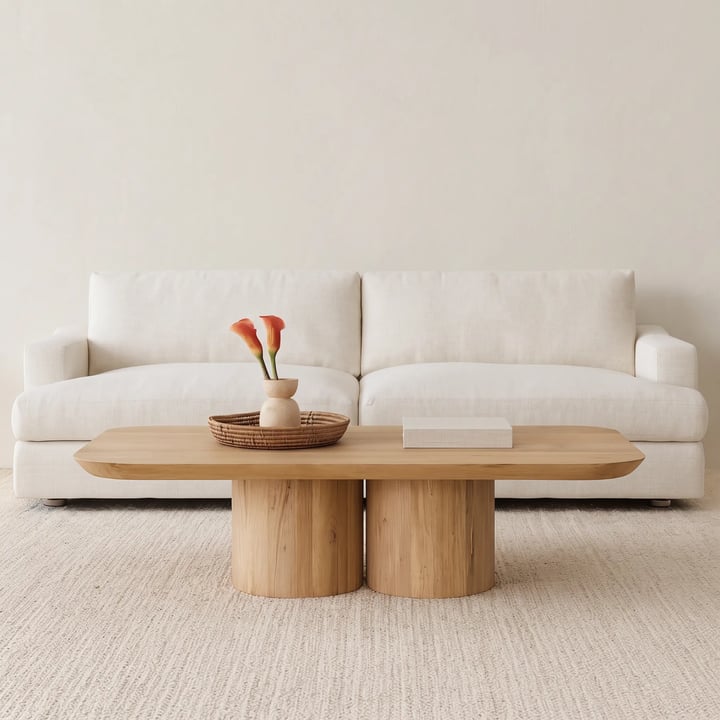
Length and depth: half to two thirds of the sofa
The length of a coffee table comes from the length of the sofa measured between the inside of the arms, not wall to wall. The usual rule says two thirds, and the honest range is half to two thirds: a 180 cm sofa takes a 100 to 120 cm table, a 200 cm sofa a 110 to 135 cm table, and a 240 cm sofa a 130 to 160 cm table. Longer than that, the table blocks the way out of the sofa and competes with it for attention; shorter, it looks like an afterthought and the ends of the sofa cannot reach it.
For a corner sofa, measure its long arm, not the whole run around the corner, and the right answer is often a square or round table that both sides can reach. When the corner is very large, two small tables that move work better than one big block in the middle.
Depth is the number that gets forgotten. For a normal sofa 50 to 60 cm is enough, and a narrow living room wants 40 to 45 cm, not a miniature table. This is the mistake we see in older flats with a living room 3 to 3.5 m wide: the table gets shrunk on every side, ends up "floating" in the middle, and nobody can reach it. Keep the length and cut the depth.
Distance from the sofa, walkways and the rug
The coffee table sits 30 to 45 cm from the edge of the sofa, with 40 cm the sweet spot, the same number we use in the living room measurements. Below 30 cm you cannot pass between sofa and table and your knees hit the edge; above 45 cm you have to get up for your glass. Deep sofas with a 60 cm or deeper seat take 45 to 50 cm, because you sit further back.
On the far side of the table the main walkway of the room needs 75 to 90 cm; where someone just slips past sideways with nothing in their hands, 60 cm will do. Between the table and the TV unit or the armchair opposite, leave 60 to 90 cm. These three gaps, not the size of the table, decide whether the room works.
The rug ties it all together. Designer Sophie Goldhill of Liddicoat & Goldhill gives the minimum: leave at least 15 cm of rug beyond the table's edge, and more is better than less. Designer Cristiana Crin of Perpetuum Designs goes further and recommends about 45 cm beyond the table on every side. In practice, the front legs of the sofa and armchairs stand on the rug, the table sits entirely inside it, and 20 to 45 cm of bare floor is left between rug and wall.
The table below gathers the numbers by sofa length. The height column assumes a 45 cm seat; for a lower sofa, take the same difference off the table.
Sofa (between the arms) | Coffee table (length x depth) | Height | Distance from the sofa |
|---|---|---|---|
Two-seater, 150 to 170 cm | 80 to 110 x 50 cm, or round 70 to 80 cm | 40 to 45 cm | 35 to 40 cm |
Three-seater, 180 to 210 cm | 100 to 140 x 50 to 60 cm | 40 to 45 cm | 40 cm |
Long, 220 to 260 cm | 130 to 170 x 60 to 70 cm | 40 to 45 cm | 40 to 45 cm |
Corner, long arm 250 cm or more | Square 90 to 100 cm, round 90 cm, or two tables | 40 to 45 cm | 40 cm from both sides |
Low lounge sofa, seat 34 to 40 cm | As above | 32 to 38 cm | 40 cm |
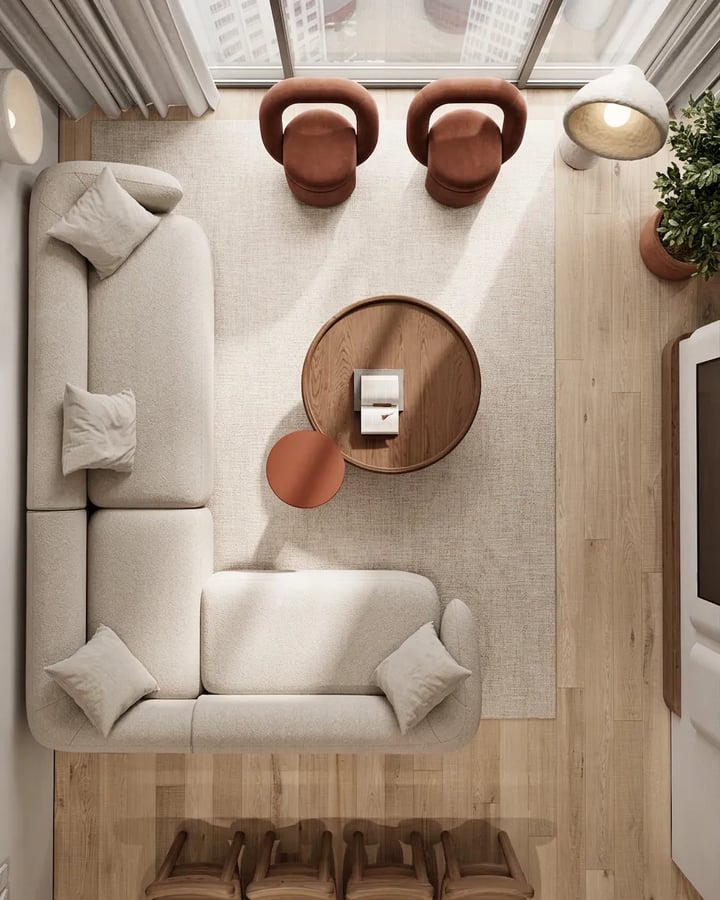
Not sure which size suits your sofa? Get in touch and we will come back with a drawing of the table at its real size in front of the sofa, together with a free quote.
Shape by room: rectangular, oval, round or square
Shape comes after the numbers, not before them. A rectangular or oval table suits a straight two or three seater and a long room, because it follows the line of the sofa. A square table suits a corner sofa with two similar arms, each reaching it from its own side. A round table is the answer for the small living room and the home with children: no corners to walk into, easy to pass around, and it softens the straight lines of the sofa and the TV unit. For a standard sofa a diameter of 80 to 90 cm is enough; for a two-seater, 70 cm.
In the older flats of Tirana, where the sofa stands against the wall and the living room is 3 to 3.5 m wide, a round or oval table 45 to 50 cm deep keeps the walkway open where a 60 cm rectangle closes it. In the open-plan living rooms of the new builds, with the kitchen in the same space, the shape is chosen from the rug and the seating group, because they, and not the wall, define the zone.
Corners deserve a word of their own. A rectangular top with 90 degree corners at 42 cm high sits exactly at the forehead height of a child who has just started walking. In the workshop, rectangular tops for homes with children get rounded corners with a radius of at least 10 mm and usually more, or we suggest the oval, which solves the problem altogether.
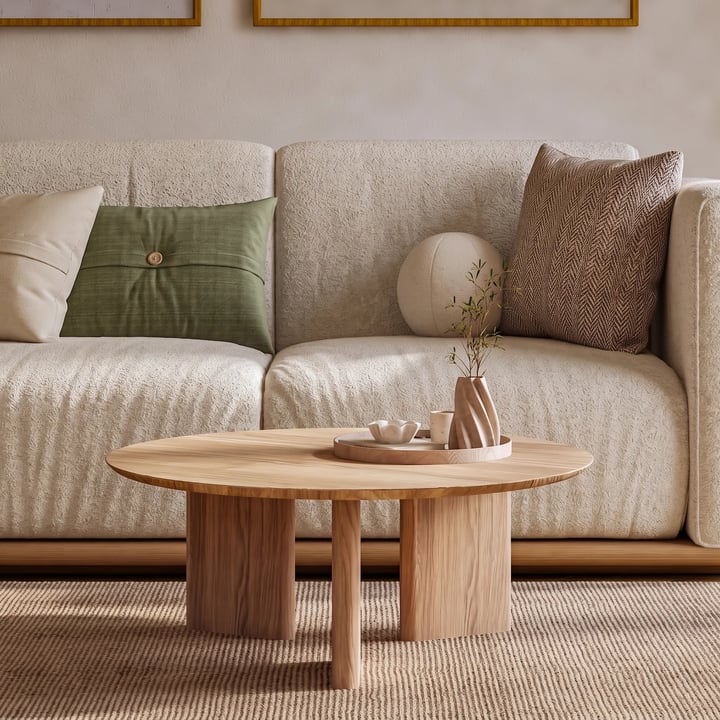
Materials: solid wood, lacquered MDF, veneer, glass or stone
The coffee table is the most touched and most loaded surface in the living room: glasses, hot cups, laptops, toys and, now and then, feet. So the material is chosen last, by how you live, not first.
Solid wood, oak, walnut or ash, with a top 30 to 40 mm thick, is the choice that ages best: scratches sand out and an oiled top is re-oiled at home. A solid wood coffee table wants coasters for the cold glass and the hot cup if it is oiled; lacquer over the wood is more sealed, but repairs only happen in the workshop. For the difference between oil and lacquer, and for what passes as solid wood in the shops, see our guide to MDF, melamine and solid wood.
Lacquered MDF is the modern coffee table of the light living room: a top with no visible joints, in white, sand, graphite or any colour, with smooth, sealed edges. A white matt lacquered table wipes clean with a damp cloth and suits a family with children; gloss lacquer shows every fingerprint. Veneer, real wood on a stable core, sits in between: the look of wood on large tops that have to stay flat.
Glass and marble are beautiful in photographs and hard in use. Glass shows every water ring and every mark and gets wiped daily; marble absorbs and stains from wine, coffee and lemon and needs regular sealing. Ilaria Barion, a New York home staging expert, advises materials that resist stains when glasses go down without a coaster, and we agree. When a client wants stone, we build a travertine or quartz top on a wood base, with protected edges, and say plainly what care it needs.
How much a coffee table has to take
A coffee table does not only hold glasses. Someone sits on it, a child climbs it, a guest pushes it aside with a foot to get past. The European standard for domestic tables, EN 12521:2023, covers exactly these cases with the EN 1730 tests, and it has a separate category for tables up to 60 cm high, which is to say coffee tables.
The test sheet of the Czech maker TON, which runs these standards in an external laboratory, gives the numbers: the top of a low table is loaded ten times with 1,000 N, about 100 kg; with 50 kg on top, the frame is pushed sideways ten times with 200 N; a 25 kg weight is dropped on it ten times from 14 cm; and the frame is pushed 5,000 times with 150 N without working loose. For you this means: the base must be rigid and the joints glued and clamped, not just screwed, and a coffee table with a lift-up top or a drawer must stay stable with the mechanism open.
When the table goes into a cafe, a hotel or a reception area, the standard for non-domestic tables applies, EN 15372, with higher loads and longer cycles; that is separate work, under our hotel furniture and restaurant and cafe furniture.
Drawer, shelf, lift-up top or ottoman
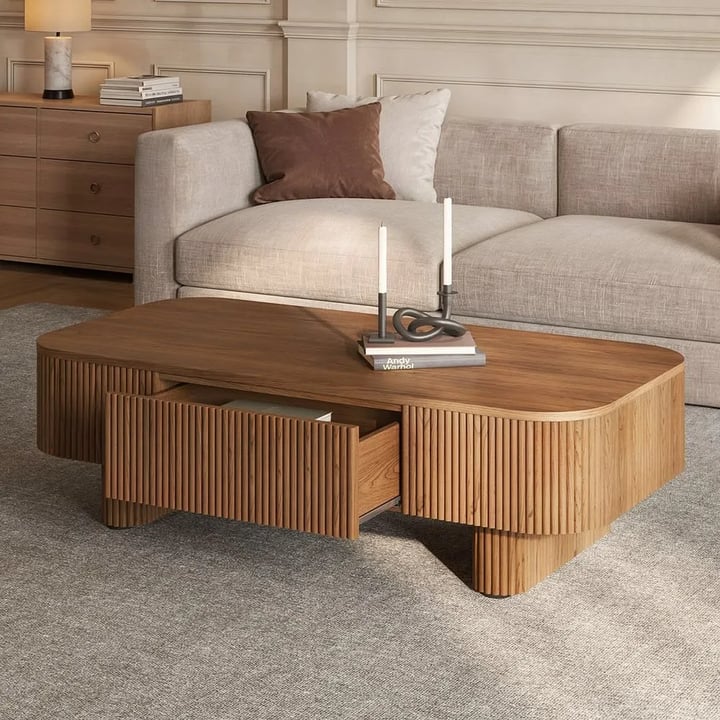
Storage decides how clear the top stays. A drawer on soft-close runners holds the remotes and chargers; an open shelf underneath holds the books and magazines and makes the table look lighter; a lift-up top over a closed compartment brings the surface up to laptop height and hides everything below. The mechanism adds weight and needs a wider base; it is planned in the drawing, not after the table is built.
A nest of tables, two or three pieces stepping down 5 to 10 cm, is the answer for a living room that changes: one table every day, three when guests come. Its weakness is that the small one often cannot hold the seating group together, so the main table of the set is built to the sizes above and the others follow it.
An upholstered ottoman with a tray is the soft alternative: no corners, a footrest, extra seating and often storage inside. For glasses it needs a rigid tray of at least 40 x 50 cm, it wears faster than a wooden top and it does not hold a laptop. Our rule: a hard top when you host or work in the living room, an ottoman when the living room is also the playroom. In living rooms that become the guest bedroom, with a sofa bed, the table should be light or on castors, and the sofa is measured open before the size is fixed.
The right order of decisions, and the mistakes we see most
On a custom table two things cannot be changed once the wood is cut: the size of the top and the height of the base. That is why the order matters, and the most common mistake is choosing the style first and the size last.
1. Measure the sofa. Seat height compressed, length between the arms, seat depth. If the sofa is not bought yet, measure the one you are going to buy, not the room.
2. Set the height. Seat height, or up to 5 cm lower.
3. Set the length and depth. Half to two thirds of the sofa; depth from the walkway that is left.
4. Choose the shape. Rectangular or oval for a straight sofa, square or round for a corner sofa and a small room.
5. Choose the material. By how you live, not by the photo.
Before you order, mark the footprint on the floor with masking tape and live with it for a day: walk past, sit down, put a glass down. That five minute test has saved more tables than any catalogue.
The mistakes that most often come to us to be put right: a table higher than the seat, which looks heavy and goes unused; a table too small for a big corner sofa, where only one seat can reach it; a table placed so far away that you stand up for your glass; a rug too small, which leaves the table straddling its edge and the room "floating"; a glass or marble top that needs care every day; and the beautiful table with no room for an actual cup, because everything on it is decor. Organiser Tina Priestly sums it up well in Livingetc's article on coffee table mistakes: people fall in love with a design without checking that it fits the scale of the room, and a table that is too large overwhelms the space while one that is too small looks lost in it.
Coffee table models: modern, classic, solid wood
The coffee table models people in Tirana ask for most come down to three, and all three are built to the same numbers above; what changes is the material, the edge and the base.
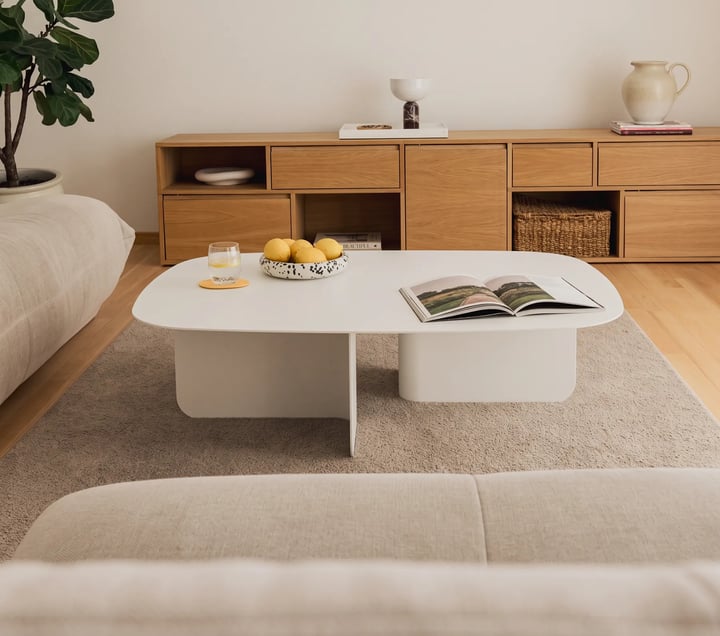
The modern lacquered coffee table. A matt lacquered MDF top in white, sand or graphite, straight or lightly rounded edges, a block base or slim metal legs. No visible joints, easy to wipe, and at home in a light living room with a TV unit in the same colour. It is the table of the minimalist living room, where the table is meant to stay quiet.
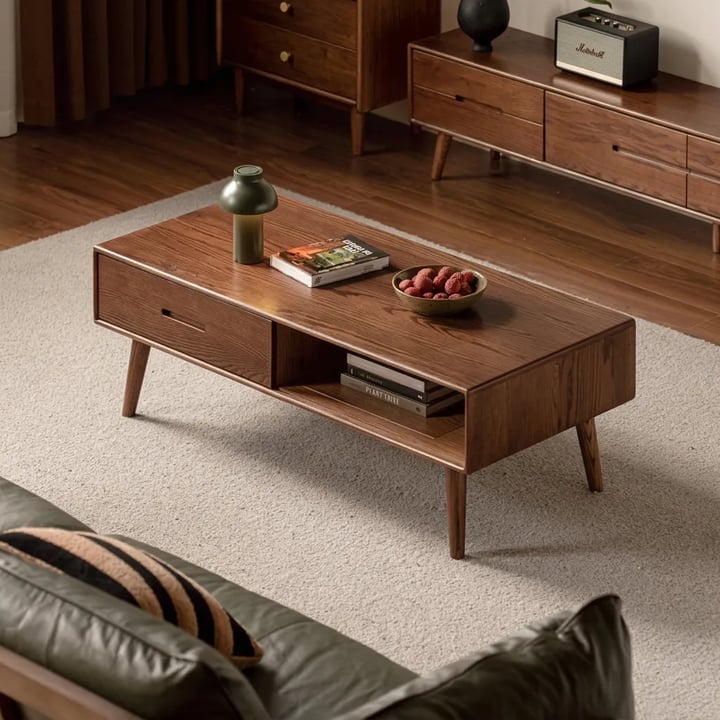
The classic solid wood coffee table. Solid walnut or oak with a visible frame, a shelf below and a profiled edge, sometimes on turned or splayed legs. It is the wooden coffee table for a living room where inherited and new furniture live together, as transitional design describes it; on slim splayed legs it becomes the mid-century table that is asked for more and more.
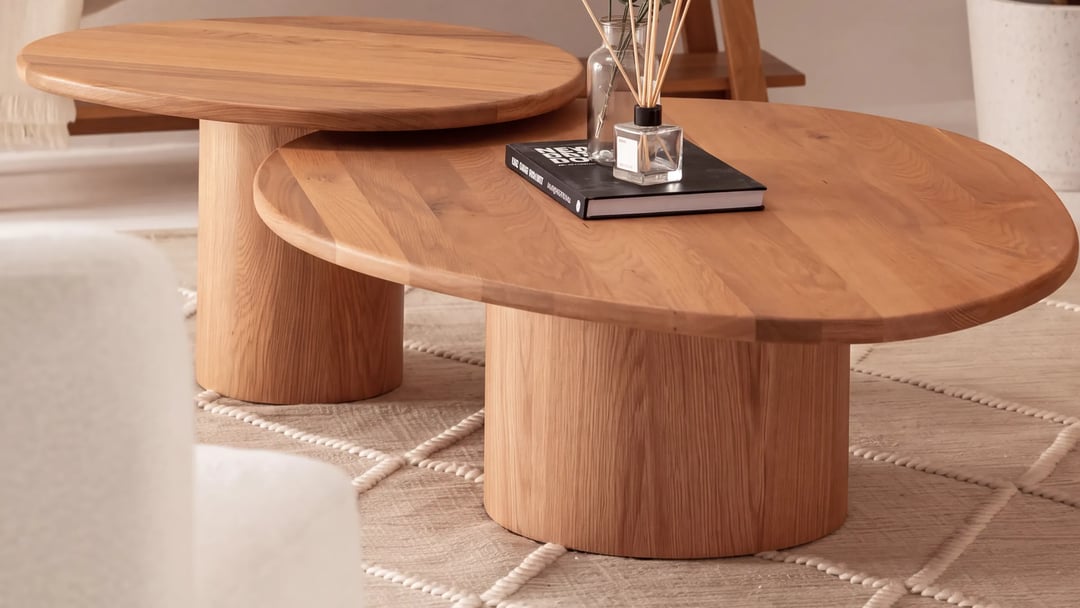
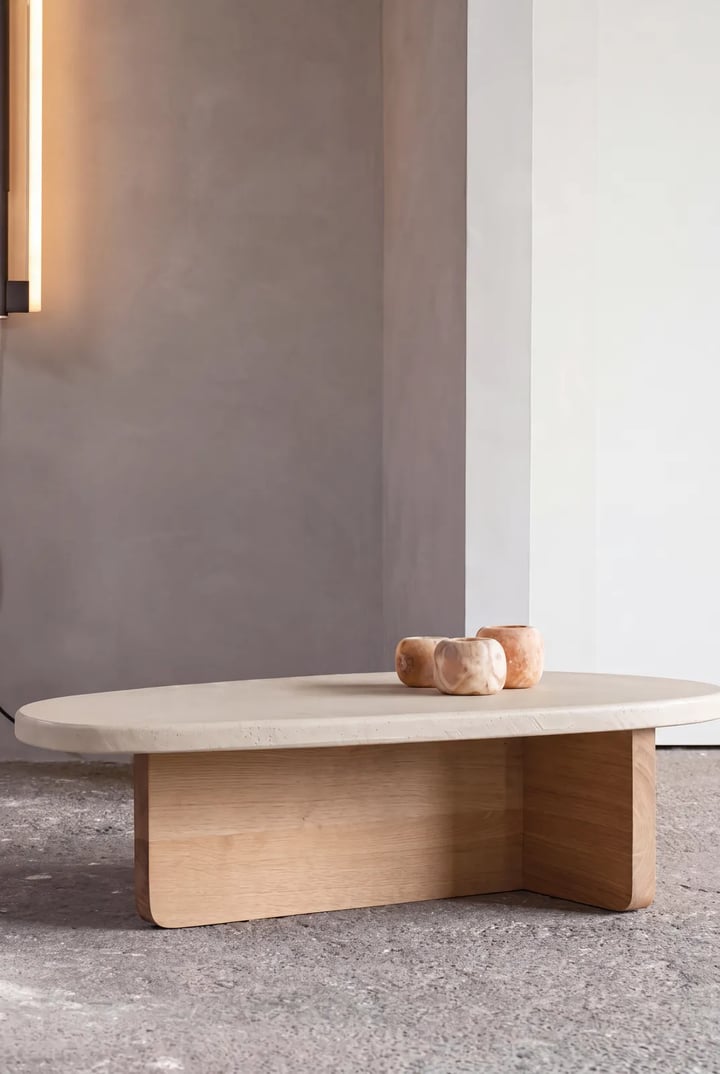
The organic coffee table, oval or round. An oval or pebble-shaped top, solid oak on round pedestals, or travertine and quartz on a wood base, often as a set of two tables that nest under one another. It is the shape of organic modern style and of the Japandi living room, where the table sits low and wide, and the natural answer for a small living room with children.
Frequently asked questions
How tall should a coffee table be?
Level with the sofa seat or up to 5 cm below it. For a normal sofa with a 43 to 48 cm seat that means 40 to 45 cm; for a low lounge sofa it drops to 32 to 38 cm. Measure the compressed cushion, not the arm of the sofa.
How far should a coffee table be from the sofa?
30 to 45 cm from the edge of the seat, with 40 cm the best measure. In small living rooms it can come down to 30 to 35 cm, but no less, because you cannot pass between the sofa and the table.
Round or rectangular coffee table?
Round or oval for a small living room, a corner sofa and a home with children; rectangular for a long straight sofa in a wide room. Both are built to the same height and distance; the only difference is how much room they leave to walk.
Solid wood or lacquered MDF?
Solid wood when you want the grain, a top that sands out and re-oils, and a table that ages well. Lacquered MDF when you want a smooth top in a colour, with no joints, that wipes clean with a cloth. Glass and marble need care every day.
Can a coffee table have a drawer or a lift-up top?
Yes. A drawer on soft-close runners, an open shelf below, or a lift-up top over a closed compartment. The mechanism is planned in the drawing so the table keeps its height and its stability.
We build coffee tables in our Tirana workshop in solid wood, lacquered MDF, veneer or with a stone top, each one to your sofa: what we build and how is on the custom coffee tables page, and the rest of the room under living and dining furniture. The cost depends on the material, the size of the top, the construction of the base and the storage; the quote is free and itemised.
If you are choosing the table for your living room in Tirana, Durrës, Vlorë, Shkodër, Elbasan or Fier, get in touch and we will come back with a drawing and a free quote.
Finished work is on our Instagram.
Want a piece like this built for you?
Get in touch and get a free price estimate, with no obligation.
Get a free quote