MDF vs Melamine: Choosing Kitchen Cabinet Materials
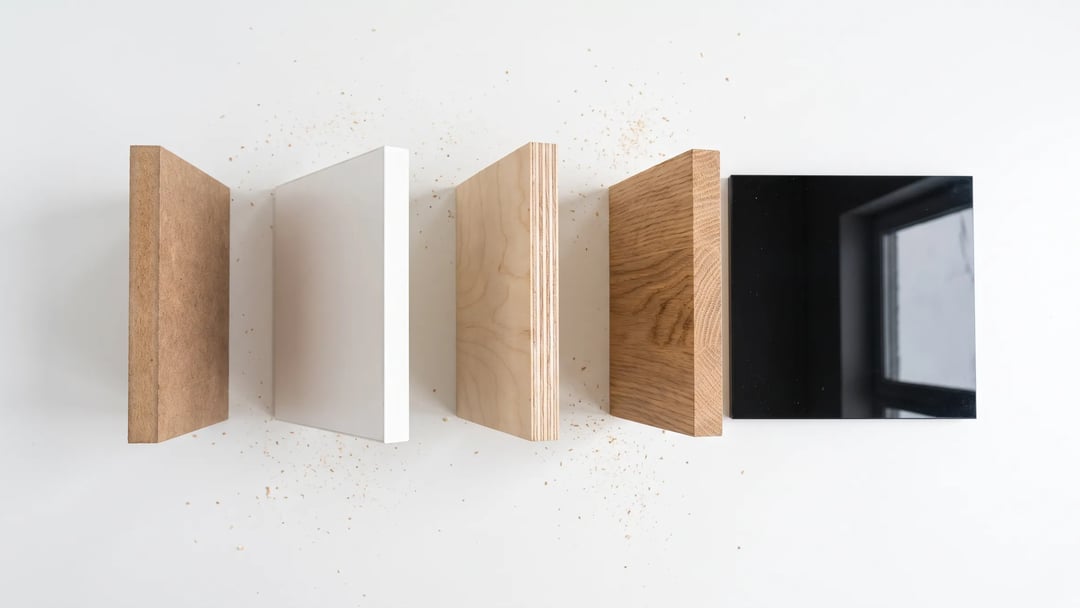
Short answer: MDF against melamine is the wrong comparison. MDF is a board, the box your cabinets are made from. Melamine is a facing, a very thin decorative paper fused onto a board under heat. You can have melamine-faced MDF. The real decisions happen in two separate places: which board forms the carcass, and what finish goes on the front you touch every day.
That confusion costs money. When someone says a melamine kitchen they usually mean a chipboard carcass with a factory-applied melamine face. When they say an MDF kitchen they usually mean lacquered MDF doors. Those are two decisions, and you can mix them.
The short version
- MDF is a core, melamine is a facing. You combine them, you do not choose between them.
- The decision that matters most is not the colour, it is what sits under your sink.
- Edge banding is where cheap furniture visibly fails first, and it cannot be fixed later.
- Solid wood is not automatically better. For a painted door, MDF behaves more predictably.
- A hotel or a restaurant needs a different surface specification from a home.
What each material actually is
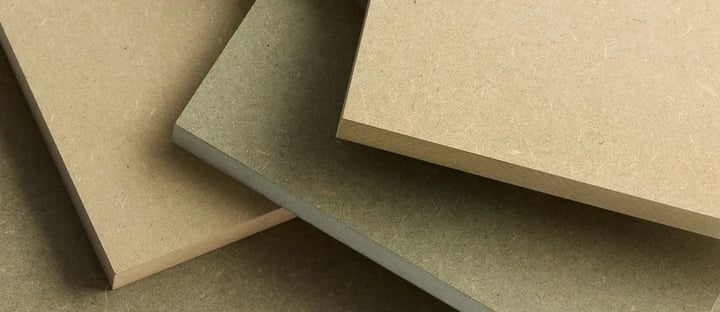
MDF. Wood broken down to fine fibres, mixed with resin and hot-pressed into a board of roughly 600 to 800 kg per cubic metre. No grain, no knots, the same density all the way through. That uniformity is why MDF is the only board that takes routing, profiles and a smooth sprayed finish. If you want a painted door, matt or gloss, there is MDF underneath it.
Moisture-resistant MDF. The same board with resins that slow water uptake. One myth worth killing: the green tint is not a guarantee. EN 622-5 classifies moisture-resistant MDF as type MDF.H by test result, not by colour. The dye only helps you tell the two apart in the warehouse.
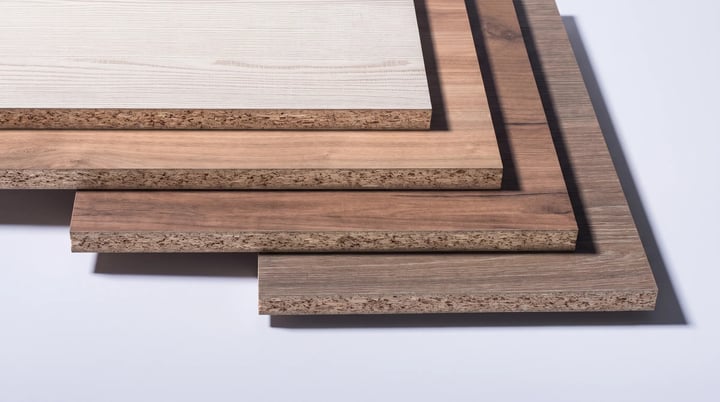
Melamine-faced board. A chipboard core with a resin-impregnated decorative paper, only 0.15 to 0.25 mm thick, fused on under heat and pressure. It arrives finished from the factory in hundreds of colours and wood prints. It is the sensible standard for cabinet carcasses and wardrobe interiors, and for most of a home it is entirely fine.
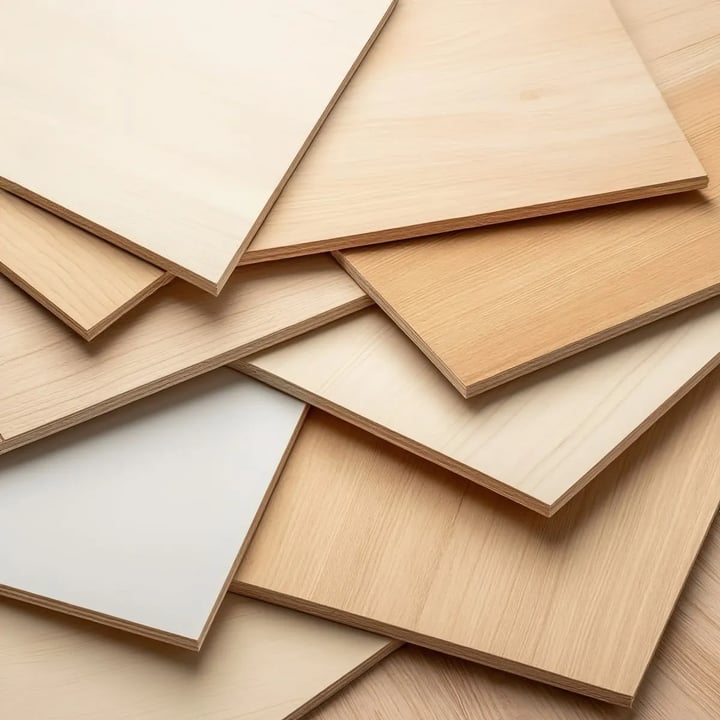
Plywood. Thin wood layers glued with the grain crossed. The strongest board for holding a screw and the most forgiving when it gets damp. It costs more, so we use it where it earns its place.
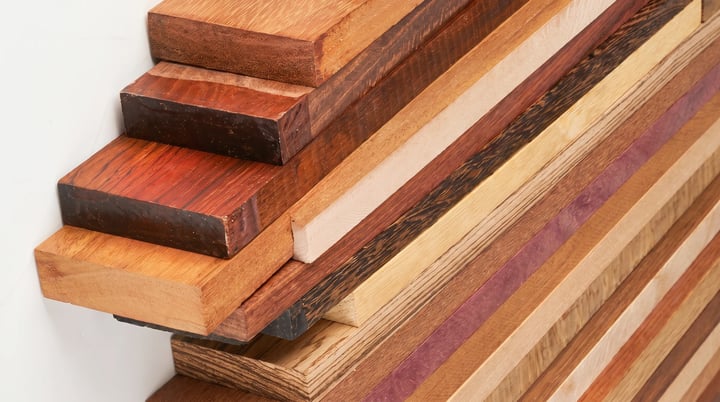
Solid wood. Oak, beech, ash, walnut, pine. It moves with the seasons, swelling and shrinking with the humidity, but it can be sanded back and refinished twenty years from now. That is its real value.
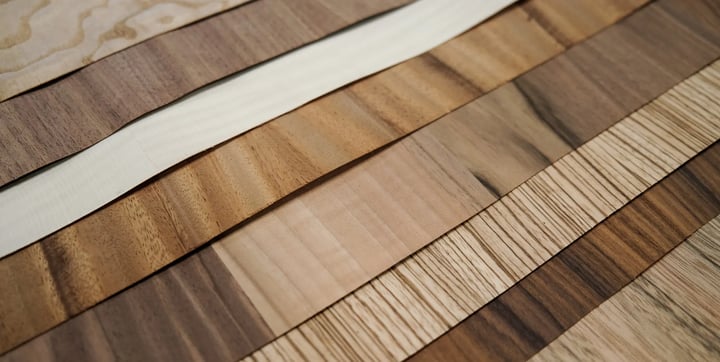
Wood veneer. A slice of real wood under 3 mm bonded to MDF or plywood. Real grain, with far less movement than solid timber.
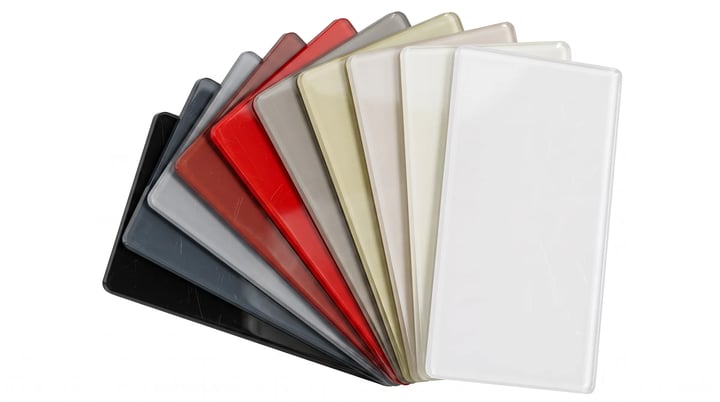
Acrylic. A high-gloss acrylic layer laminated to MDF. Hard surface, colour that holds, and it shows every fingerprint. Matt anti-fingerprint versions exist and are worth the look at.
PVC, also sold as thermofoil. A vinyl film vacuum-wrapped over MDF. Cheap and seamless, and the first finish to fail near heat.
The carcass and the front are separate decisions
This is the split most quotes do not spell out, and the one you should ask about.
The carcass is the box: sides, shelves, base, and the material your hinges and drawer runners screw into. Appearance is irrelevant here because you never see it. What matters is screw-holding and how the board behaves when it gets wet. Standard thickness is 16 or 18 mm, and we ask for 18 mm on long shelves and on the sides that carry hinges.
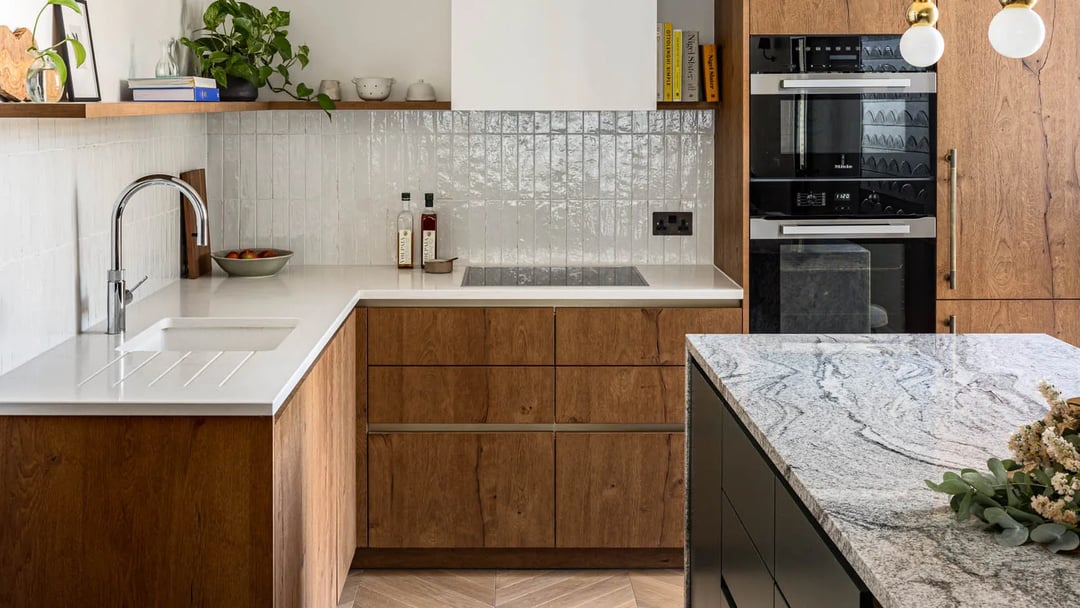
The front is the door and the drawer face. That is where the look, the price and the five-year appearance are decided, and where the interior style you are building toward actually shows up. Which fronts, colours and surfaces look current this year, see modern kitchen trends 2026.
For most homes in Tirana the sensible combination is a melamine-faced carcass with lacquered MDF or acrylic fronts. Pay for what you see and touch, save on what stays shut.
One detail that cannot be fixed later is screw-holding. MDF holds a screw better than chipboard, and plywood and solid wood beat both. That ordering is why hinges in a cheap carcass start to sag after a few years of daily opening, while the door itself still looks fine.
Water is the real enemy, not the material
Standard MDF and chipboard have no problem with humid air. They have a problem with liquid water reaching an unsealed edge.
The numbers are blunt. After 24 hours submerged, standard MDF typically swells around 10 to 15 percent in thickness, so an 18 mm board passes 20 mm, and part of that swelling never reverses. Moisture-resistant MDF swells roughly half as much. EN 312 caps thickness swelling for humid-environment P3 board at around 14 percent, while standard P2 furniture board carries no water requirement at all. That is precisely why the carcass under your sink should never be plain P2.
Tirana averages about 67 percent relative humidity across the year, peaking near 74 percent in November. A well-built kitchen shrugs that off. An older apartment with condensation, a ground floor, or a place near the coast does not forgive a single unsealed edge.
The rule we work to: moisture-resistant MDF or plywood for the carcass under the sink, beside the dishwasher and in bathroom vanities. Standard melamine everywhere else. It costs a little more and it removes the cause of most complaints.
Edge banding, the 1 mm that shows everything
Every cut edge of a board is open. The edge band is what seals it. When the band lifts, water gets in and the board swells. When it chips at a corner, the whole unit looks cheap even if everything behind it was done properly.
Ask for 2 mm PVC banding on fronts and visible sides, not the thin 0.4 mm strip used to hit a price. Ask how it is bonded, too. PUR adhesive, or laser edging with no visible joint at all, survives steam and repeated cleaning far longer than standard hot-melt glue.
Edge banding, carcass material and hinge boring are the three things you cannot change afterwards. Door colour you can change. Those you cannot.
See how we build carcasses and edges, step by step, then compare it against the quote in front of you.
How the materials compare
Material | Where it belongs | Its strength | Watch out for |
|---|---|---|---|
Melamine-faced chipboard | Carcasses, wardrobe interiors, shelving | Cheapest, hundreds of finishes, factory-flat | Swells permanently if water reaches a raw edge |
Standard MDF | Painted and lacquered fronts, profiled doors | Takes routing and a flawless sprayed finish | Not for wet zones without a sealed edge |
Moisture-resistant MDF | Under the sink, beside the dishwasher, bathroom vanities | Roughly half the swelling of standard MDF | The green tint alone proves nothing, ask for the type |
Plywood | Carcasses that carry weight, damp rooms | Best screw-holding of any board | Costs more, visible edges need care |
Solid wood | Frames, visible timber, pieces meant to last decades | Can be sanded and refinished decades later | Moves with humidity, can split at joints on wide doors |
Wood veneer | Fronts where you want real grain | Real wood look, far more stable than solid | Cannot be sanded back more than once |
Acrylic | High-gloss fronts | Hard, colour-stable, deep gloss | Shows every fingerprint in a family kitchen |
PVC or thermofoil | Budget fronts away from heat | Cheap, seamless, no visible joints | Lifts and blisters above roughly 70 degrees |
What each material costs, in order
Kitchens in Tirana are usually quoted per linear metre. We do not publish prices, because a real number depends on your layout, your appliances and your hardware, but the ranking never changes. From least to most expensive on the fronts:
- Melamine, the starting point
- PVC or high-pressure laminate
- Lacquered MDF, and wood veneer alongside it
- High-gloss acrylic
- Solid wood
The spread between the cheapest and the dearest front is wide. The carcass moves the total far less, and that is exactly why saving there is the wrong economy: you save a small amount on the part that fails, and pay it back when a swollen base panel has to come out.
For hotels, restaurants, cafes and offices
When a hundred hands open the same door every day, the arithmetic changes.
Surfaces. Standard melamine is built for homes. For counters, receptions and tables, high-pressure laminate takes far more abrasion than melamine and tolerates commercial cleaning chemicals much better.
Edges. ABS or PUR banding, not the base strip. In contract use the failure always starts at a corner.
Replacement. Insist that the board brand and the decor code appear in the quote. When one door out of a hundred is damaged in year two, you want to replace that one door, not the set. Decors drift between production batches.
Formaldehyde. Boards are sold by emission class. European E1 allows up to 0.124 mg per cubic metre. EU Regulation 2023/1464 lowered the limit for wood-based furniture and articles to 0.062 mg per cubic metre from 6 August 2026. For a hotel room or an office packing a lot of furniture into a small volume of air, that is a fair question to put to any supplier.
We build for hotels and for restaurants and cafes to the same drawings we use at home, with the surface specification changed for the traffic.
What usually goes wrong
1. A cheap carcass under the sink. A small drip over six months and the board swells permanently. You do not repair that, you replace it.
2. PVC fronts next to the oven or the dishwasher. The film lifts and blisters above roughly 70 degrees. The fix is a new door, not a repair, because the film cannot be reliably re-bonded.
3. Dark gloss in a family kitchen. Acrylic and gloss lacquer look superb in a showroom and show every fingerprint at home. Matt, or anti-fingerprint matt, is the choice nobody regrets.
4. Thin edge banding to hit a price. It saves very little on the quote and ruins the look within two years.
5. Solid wood in the wrong place. A large solid door in a room with swinging humidity moves, and can split at the joints. For a painted door, MDF is the more stable choice.
Six questions to ask before you sign
1. What board is the carcass, and how many mm?
2. Is the carcass moisture-resistant under the sink and in the bathroom?
3. How thick is the edge banding, and how is it bonded?
4. What is the front material, and what is underneath it?
5. What is the board brand and the decor code?
6. What is the emission class, E1 or lower?
Answer all six clearly and you are dealing with a serious workshop. If the answer is only good European material, ask again for the details.
Frequently asked questions
Does MDF swell under the sink?
Standard MDF does swell if water reaches an unsealed edge, and part of that swelling is permanent. Normal humidity is not the problem. The fix is moisture-resistant MDF in the wet zones plus edge banding that is properly sealed.
Is MDF the same as melamine?
No. Melamine is a thin decorative facing bonded to a core board, usually chipboard. MDF is a core board in its own right. You can buy melamine-faced MDF, which is exactly why the comparison confuses so many buyers.
Solid wood or MDF for wardrobe doors?
For painted doors, MDF is more dimensionally stable and gives a cleaner finish. Solid wood makes sense when you want visible grain, or a piece that can be refinished decades later. For the inside of the wardrobe, melamine-faced board is plenty, and the depths, rail heights and clearances matter far more than the board does.
How these materials behave inside a closed wardrobe, and which door type suits your room, is in wardrobe types compared.
Acrylic or matt lacquer for fronts?
Acrylic has a harder surface and more stable colour, but it costs more and shows fingerprints. Matt lacquer hides marks better and can be spot-repaired. In a family kitchen, matt almost always wins.
Why do thermofoil cabinets peel?
The vinyl film delaminates from the MDF above roughly 70 degrees, so it fails first above ovens, beside dishwashers and near kettles. Once it lifts it cannot be reliably re-bonded, so the door gets replaced.
Where to start
Before you compare quotes, walk your kitchen and mark the three wet spots: under the sink, beside the dishwasher, and wherever the kettle lives. Those are the places to spend. Then settle the front finish, which is the part you will look at every morning. The worktop heights and unit sizes follow from the layout, not from the material.
With over 30 years of woodworking behind the workshop, we write these details into the quote from the start, because they are what decides whether your kitchen still looks right in ten years. See the custom kitchens we build and the wardrobes and storage that use the same carcasses.
We measure in your home in Tirana and give you a quote that states exactly which board goes where and why. Book your free measurement.
Want a piece like this built for you?
Get in touch and get a free price estimate, with no obligation.
Get a free quote