Bed Sizes in cm: Single, Three-Quarter, Double, King
Search for a single, double or three-quarter bed in Tirana and almost every listing gives you one number: 90 x 190, 120 x 200, 160 x 200. That number is the mattress, not the bed. The frame is always bigger, sometimes by tens of centimetres, and that difference decides whether there is still a walkway beside the bed.
In our workshop we build custom beds from the idea or photo you bring us, and the questions we hear repeat: how wide is a three-quarter bed, 140 or 160 for a couple, is a lift-up storage bed worth it, how far apart should the slats be. This guide answers them in order, with bed sizes in centimetres and the room each one needs.
Two misconceptions about bed sizes
A bed's name tells you the mattress that fits inside it. The mattress is made slightly smaller than the frame's inner space so it sits square without sliding, and the frame is built around it: the side rails, the headboard, sometimes a footboard too.
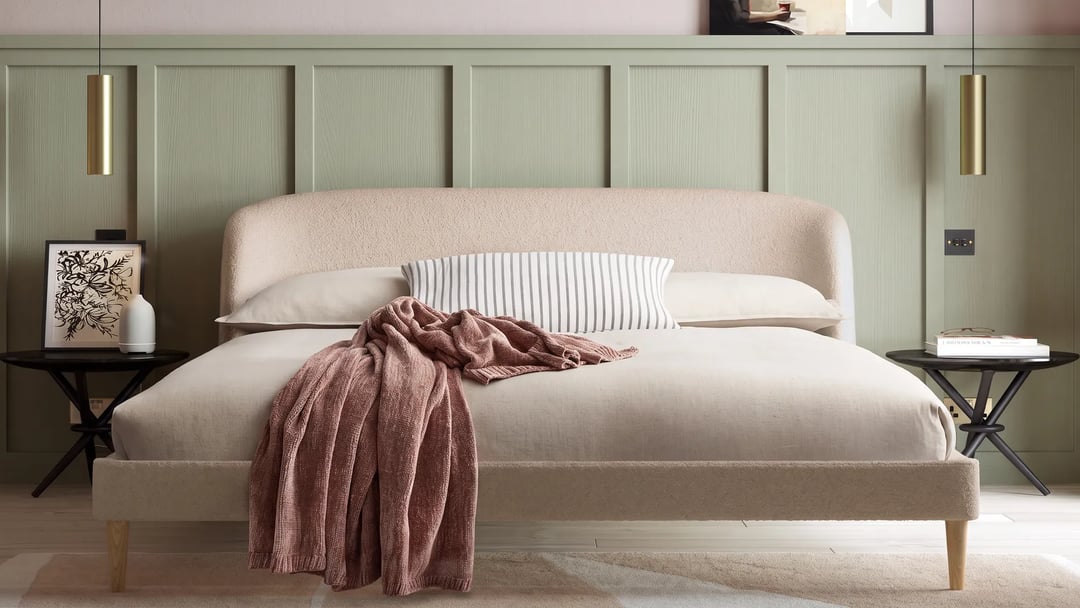
How much does the frame add? A simple wooden frame adds about 5 cm on each side, so a bed for a 90 x 200 mattress takes about 100 x 210 cm of floor. An upholstered frame with a padded headboard adds far more. In the catalogue of Selishome, a Turkish furniture retailer, beds for a 160 x 200 mattress measure 200 to 310 cm wide and 225 to 243 cm long on the outside, depending on the model. The same size in the listing, more than a metre of difference on the wall.
The consequence is simple: draw the room around the frame, not the mattress. The walkway beside the bed, 60 cm as a minimum and 70 to 75 cm to feel comfortable, is measured from the edge of the frame, as we set out in our guide to wardrobe and bedroom dimensions.
The second misconception comes from the name. A three-quarter bed sounds almost like a double and is often bought for two. At 120 cm wide, two adults get 60 cm each, while a single bed gives one person 90 cm. For one adult it is a generous, comfortable bed; for two people every night it is tight.
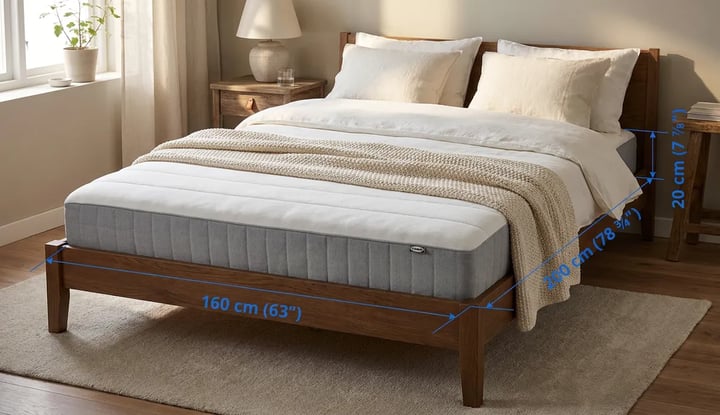
Bed sizes in cm
Shops in Albania sell in centimetres, which helps, because the names do not match from one country to the next. A queen in Europe is 160 x 200, in the US 152 x 203. A British small double is 120 x 190, which is what Albanians call a three-quarter bed. When you order, give the numbers.
In English the naming is messier still: three-quarter bed, small double and 4ft all describe the same 120 cm width, and a UK double at 135 x 190 is narrower and shorter than the continental 140 x 200.
Length has its own history. According to Wikipedia, until the 1980s the most common mattress length in Europe was 190 cm, while today 200 cm is the length pan-European retailers sell most. In Albania both lengths are still on sale, and many doubles in local catalogues come as 160 x 190.
The rule for choosing between them: the mattress should be at least 10 to 15 cm longer than the tallest person sleeping on it. The French guide Matelas Expert puts it briefly: 90 x 200 is the standard for an adult, and for anyone over 1.75 m the extra 10 cm is essential.
Type | Mattress (cm) | Width per person | Who it suits | Headboard wall needed |
|---|---|---|---|---|
Single | 90 x 190 or 90 x 200 | 90 cm | A child, a teenager or one adult | About 160 cm, against a wall |
Three-quarter | 120 x 190 or 120 x 200 | 120 cm for one, 60 cm for two | One adult who wants room | About 190 cm against a wall, 250 cm free-standing |
Double | 140 x 190 or 140 x 200 | 70 cm | A couple in a narrow room | About 270 cm |
Wide double | 160 x 190 or 160 x 200 | 80 cm | A couple, the comfortable choice | About 290 cm |
King | 180 x 200 | 90 cm | A couple who want two singles' width | About 310 cm |
The last column assumes a simple frame, about 5 cm on each side, and 60 cm of walkway on every side someone walks. For 75 cm walkways add 30 cm; for an upholstered frame, use its real outside width. A 200 x 200 exists too, but it rarely fits an Albanian apartment.
Single or three-quarter: when one person sleeps
A 90 x 200 single serves one person from childhood into adult life. The 90 x 190 version is still sold and takes 10 cm less floor, but it is short for anyone over 1.75 m. If the bed is for a teenager who is still growing, choose 200. For younger children, from the cot to a single with a guard rail, the sizes by age are in our guide to children's bed types by age.
The three-quarter bed is the real question. In Britain it is called a small double and is 120 cm wide. In Albania the name is used more loosely: in listings, where it is often spelled trecereksh, you will find three-quarter beds at 120 x 190 but also at 140 x 190. So when you see the word, ask for the number. A 140 sold as a three-quarter is really a narrow double.
When is a three-quarter bed the right answer? For one adult who moves a lot in their sleep, for a teenager who wants more than 90 cm, or for a guest room where a double would close the walkway. For a couple every night, no: 60 cm each is 30 cm less than each gets in a single.
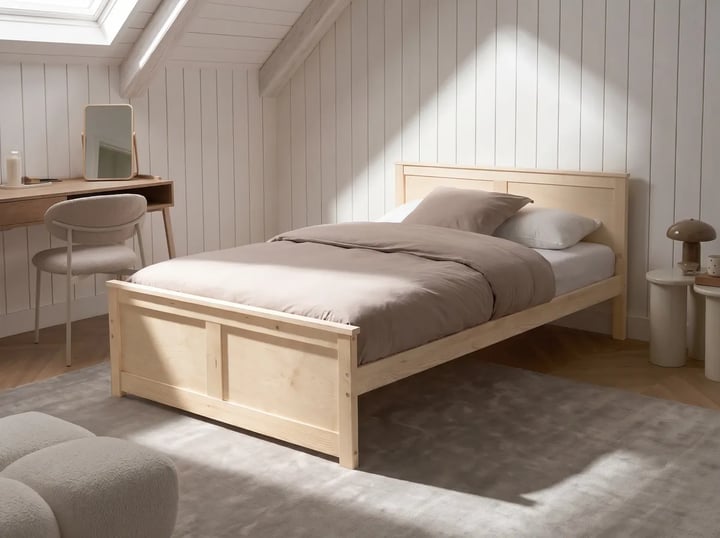
Double beds: 140, 160 or 180 cm
Double beds come in three widths that differ more than they look on paper. 140 cm gives two people 70 cm each, 160 cm gives 80, and 180 cm gives 90, a single bed's width each.
In our experience, 160 x 200 is the point where a couple sleeps comfortably without feeling each other move. 140 x 200 works, especially for couples who sleep close, and it is the sensible choice when the room cannot give 60 cm of walkway on both sides of a 160. When the choice is 20 cm of mattress against 20 cm of walkway, choose the walkway.
180 x 200 has an advantage no other size has: it can be built for two 90 x 200 mattresses on one frame, so each sleeper picks their own firmness, and two single mattresses go up an apartment stairwell far more easily than one 180 cm mattress. It needs about 310 cm of wall, so a room of about 4 x 4.5 m, as the room table in our modern bedroom design guide shows.
The same length logic applies as for a single. Many doubles in Albania are sold as 160 x 190, and if either of you is over 1.75 m, it is worth asking for 200.
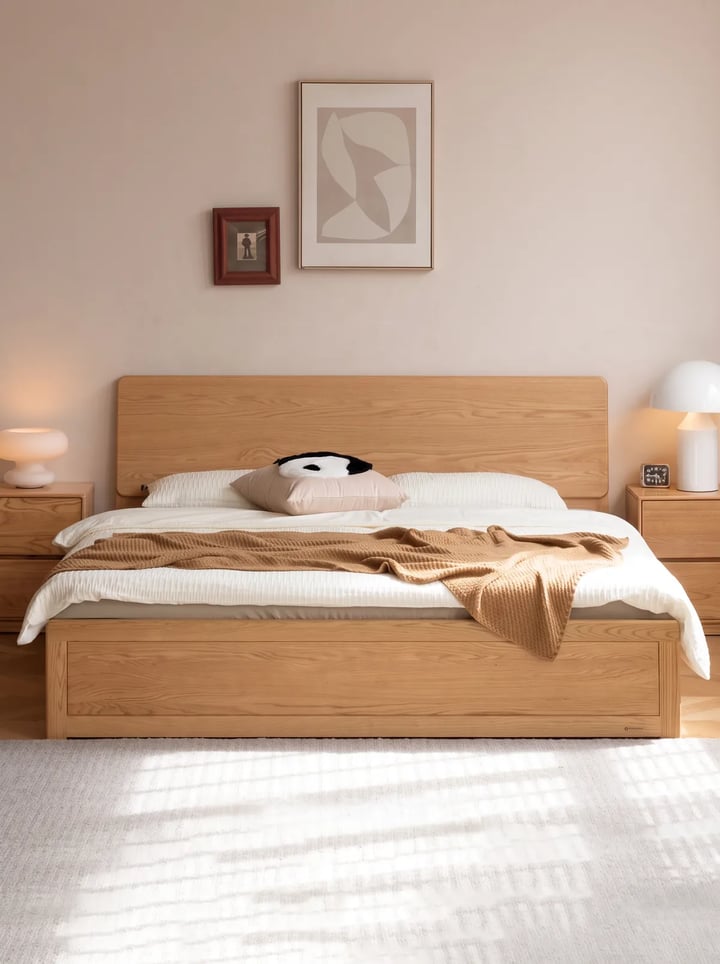
Lift-up, storage or drawer beds
In apartments where the wardrobe is never enough, the space under the bed is the largest unused volume in the home. There are three ways to use it, and each needs different floor around it.
The lift-up storage bed. The whole base, mattress included, rises on two gas pistons and opens a storage well the size of the bed. In Albanian listings it appears as krevat me mekanizëm, me kontenitor or me depo: the container word describes the space, the mechanism word describes how it opens. It gives the most storage, but the base lifts from the foot or from the side, and that side must stay clear. A lift-up double pushed with its foot against a wardrobe does not open.
Pistons are chosen by the weight they lift, and their force is rated in newtons. According to Autorce, a British gas strut supplier, 800 N is the common choice for most double and king ottoman beds. A strut that is too strong slams the bed shut or makes it hard to close, one that is too weak makes lifting heavy. The force is calculated for the base and mattress together, so a heavier new mattress can need different pistons. And they are always replaced in pairs, because a single new piston lifts the base unevenly.
The drawer bed. Two or three deep drawers that pull out from the side or the foot. They hold less than a lift-up base but open every day without lifting anything, so they suit sheets and clothes in daily use. They need about 90 cm of clear floor on the side they open.
Under-bed boxes. The simplest option, needing only a frame that sits high enough off the floor. They hold less than drawers and have to be pulled out and pushed back by hand every time.
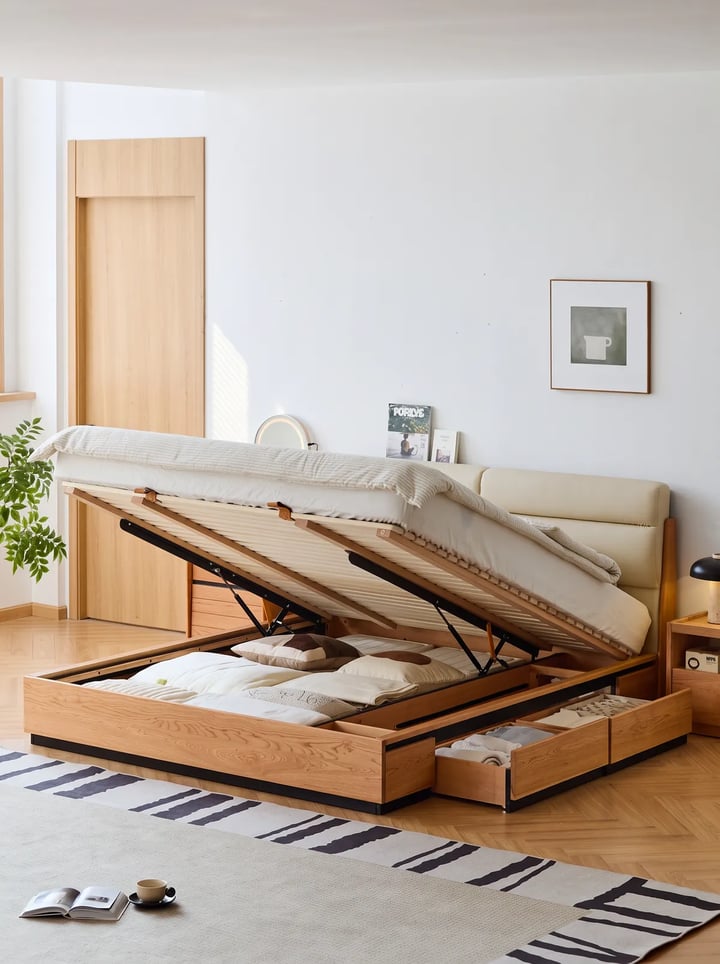
Not sure a lift-up bed can open in your room? Get in touch and we will look at it together. We build custom beds in Tirana, Durrës, Vlorë, Shkodër, Elbasan and Fier.
The slatted base: the slats that protect the mattress
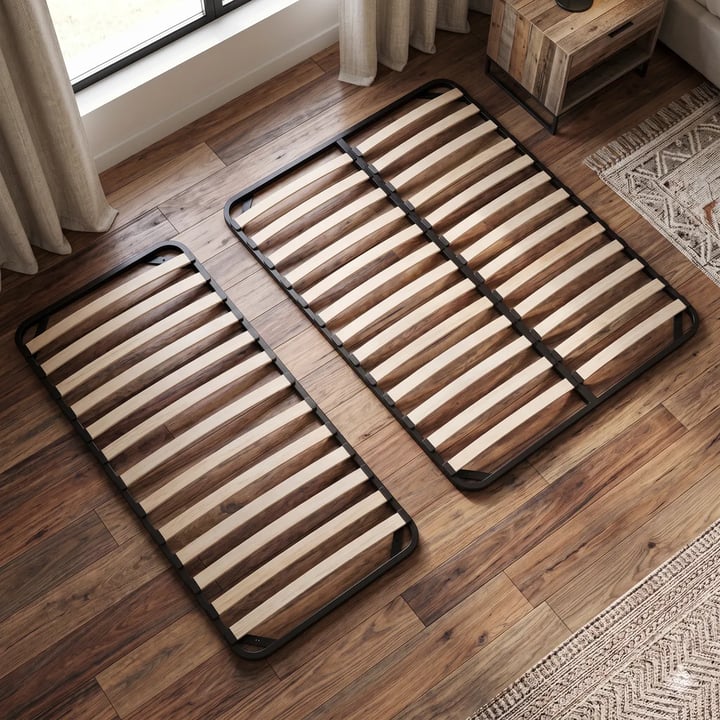
The slatted base is the part of the bed nobody sees and the part that decides how long the mattress lasts. When the slats are far apart the mattress sinks into the gaps, and on foam or memory foam mattresses that leaves permanent dips in the pattern of the base.
Mattress makers write this into their guarantee terms. The British maker Simba, for example, asks for slats more than 5 cm wide and no more than about 7.5 cm apart, and treats an unsuitable base as a lack of reasonable care that can lead to a guarantee claim being refused. The number varies from maker to maker, so read your mattress's terms before the base is ordered.
Three rules we follow: slats close together for foam mattresses, a centre rail with legs down to the floor on every double bed, and curved wooden slats that flex without breaking. A solid board base holds the mattress but lets it air less, and Simba likewise does not recommend the floor or similar solid surfaces, because the mattress cannot breathe.
For the frame itself, the European standard for adult beds is EN 1725. According to SATRA, the British testing centre, the 2023 revision replaced the 1998 version, now also covers non-domestic use such as hotels as well as guest beds, and sets its test forces for a user weighing up to 110 kg.
Double and single bed styles: which one for which room
Once the size is chosen, the room and the way you use it decide the style. These are the beds we are asked for most, with what to know about each.
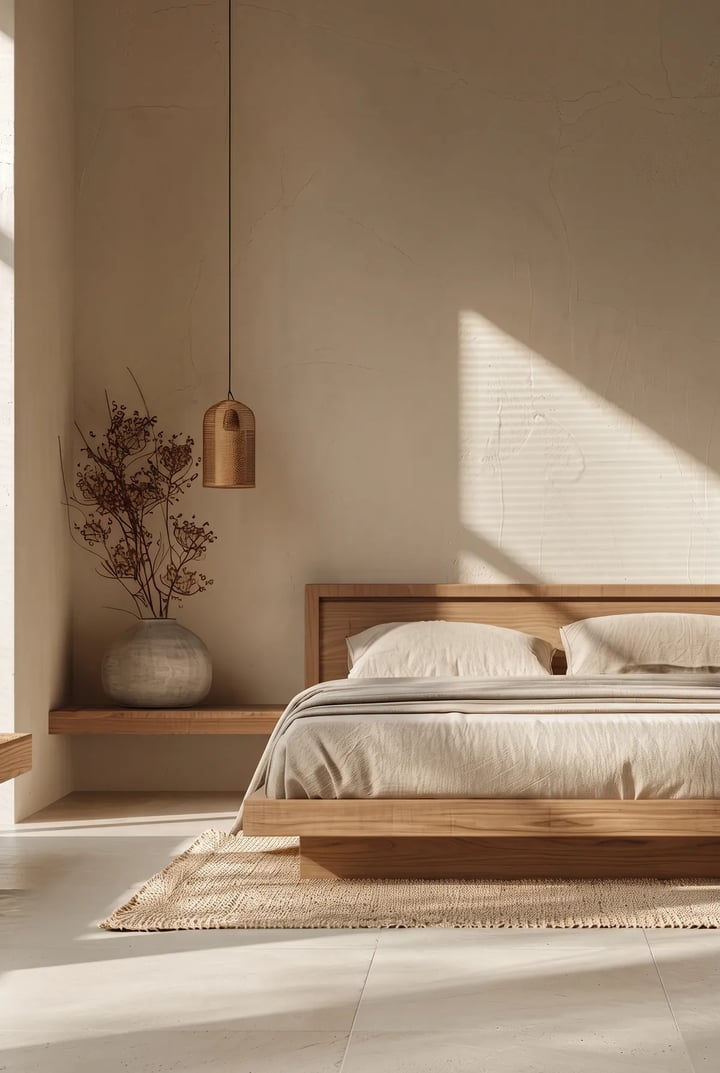
The low platform bed. The mattress sits just above the floor on a recessed base that seems to float. It makes the room feel taller and calmer, and it is the typical bed of Japandi style. Watch the height: sitting on the edge, your feet should reach the floor without bending your knees sharply, so a very low platform is not the answer for someone with tired knees.
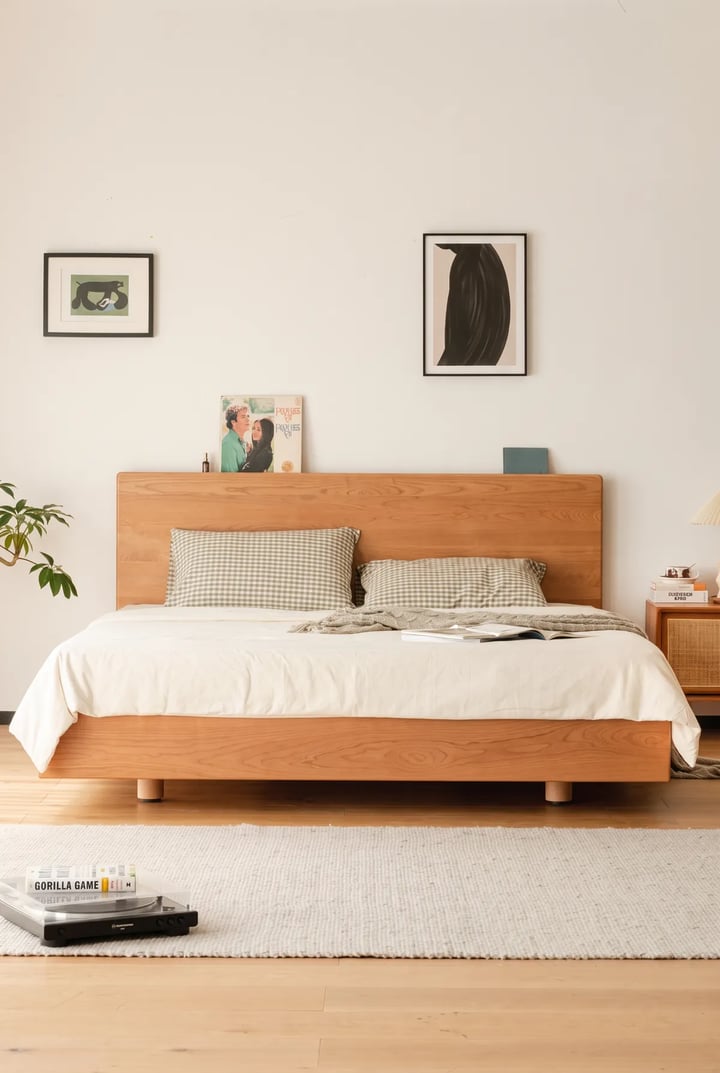
The solid wood bed on legs. A frame on visible legs leaves the floor clear underneath, cleans easily and makes a small room feel more open. Solid wood takes the years and can be repaired; how it differs from veneered boards is covered in MDF vs melamine: choosing cabinet materials.
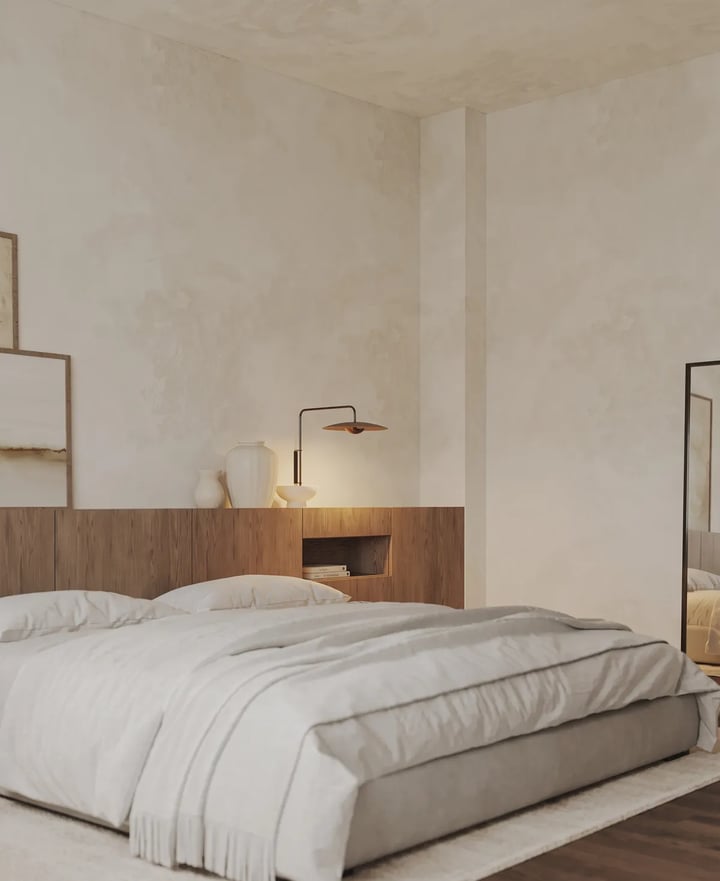
The upholstered bed. The base, and often the headboard, covered in fabric, frequently with a lift-up mechanism below. It is the most comfortable bed to lean against while reading, but the padded frame adds more centimetres around the mattress, so measure the outside width twice. When the headboard becomes a panel with a niche, it replaces the nightstand and keeps the room clutter free, which is the principle behind minimalist interior design.
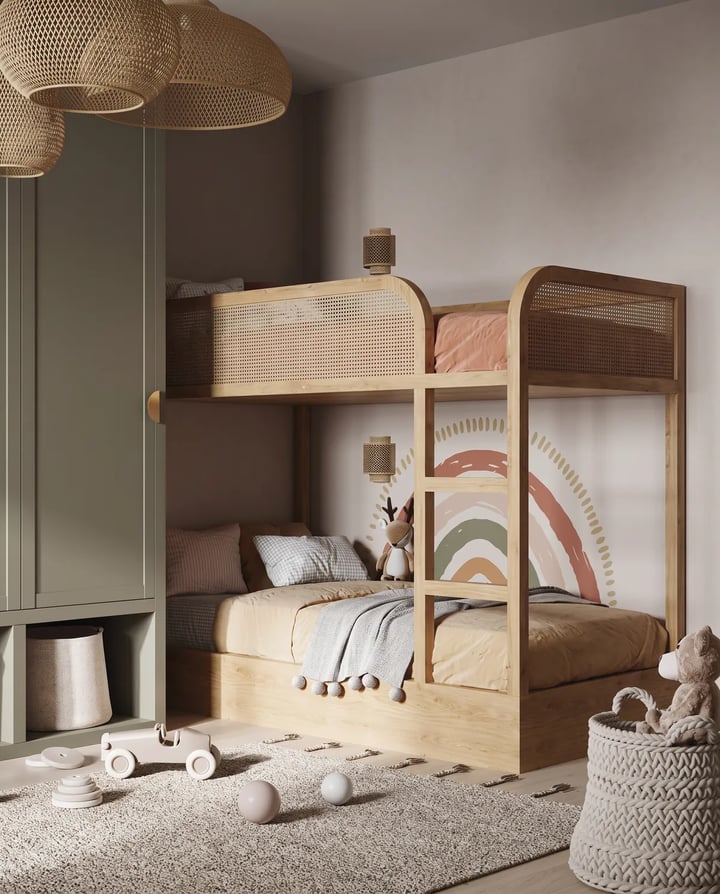
The bunk bed. Two single beds stacked, the answer when two children share a small room. The top bunk is for children aged 6 and over, with a guard rail on every side, a mattress no thicker than 15 cm and a ceiling that allows it. The full rules are in our guide to bunk beds and loft beds for children.
How to measure the room before choosing the bed
1. Measure the room, not the bed. Full length and width, including niches and corners. Mark the door, the window, the radiator and the sockets.
2. Pick the headboard wall. The longest unbroken wall, away from the door and not facing it, so both sides of the bed stay usable.
3. Subtract the frame, not the mattress. Take the outside width of the model you like and see what is left. You need 60 cm on every side someone walks, and 100 cm from the foot of the bed to the wardrobe.
4. Check every opening. If the bed has a lift-up base, the side it lifts from must be clear. If it has drawers, about 90 cm in front of them. Draw the swing of the room door and the wardrobe doors too.
5. Measure the way into the room. The building entrance, the lift, the turn of the stairs, the hallway. A one-piece frame or a 180 x 200 mattress may not make the turn. In our room by room measurements guide we explain why more furniture gets stuck at the door and on the stairs than inside the room. A frame that comes apart in sections solves this, and that is decided before it is built.
Six things are settled before building starts and do not change afterwards: the mattress size, the height and type of headboard, the side the lift-up base opens from, the side the drawers pull out, the type of base and the total height of the bed. Bedding, wall colour and nightstands can change later; these six cannot.
The mistakes we see most often
1. Ordering by the mattress. A 160 x 200 bed is chosen for a 280 cm wall, and the upholstered frame turns out 200 cm wide. That leaves 40 cm on each side, below the minimum.
2. A mattress that does not match the frame. A 160 x 190 mattress in a frame for 160 x 200 leaves a 10 cm gap at the foot, and the reverse does not fit at all. Compare the frame's inner size with the mattress before you buy either.
3. A lift-up bed with no room to open. Pushed with its foot against a wardrobe or its side against a wall, the storage stays closed for good.
4. Slats too far apart. The mattress sinks between them, the dips never recover, and the maker can refuse the guarantee.
5. A frame that does not fit up the stairs. A one-piece frame gets stuck at the turn of the stairs or at the bedroom door, and goes back.
6. A bunk bed for a child under 6. The top bunk is not for this age, however sturdy the bed looks.
Frequently asked questions
How wide is a three-quarter bed?
Usually 120 cm, with a length of 190 or 200 cm. In Albanian listings the name is also used for beds up to 140 cm wide, so always ask for the size in centimetres. For one adult it is comfortable, for two people every night it is tight.
What are the dimensions of a double bed?
140 x 200 and 160 x 200 cm sell most, and many models in Albania come as 160 x 190. 180 x 200 is called a king. These are mattress sizes: the frame comes out anywhere from about 10 cm to more than a metre wider, depending on the model.
Is a lift-up storage bed worth it?
Yes, when the wardrobe is not enough and the room has clear floor on the side the base lifts from. It gives the most storage under the bed, but for things you use rarely: duvets, suitcases, out of season clothes. For everyday sheets, drawers are more practical.
How far apart should bed slats be?
As far as your mattress maker allows, usually stated in the guarantee terms. For foam mattresses the safe rule is no more than about 7.5 cm between slats. A double bed also needs a centre rail with legs down to the floor.
What size bed fits a small bedroom?
Measure the headboard wall and subtract the frame plus 60 cm for every side someone walks. A 270 cm wall takes a 140 x 200 double with a simple frame, a 290 cm wall takes a 160 x 200. In a room of about 2.7 x 3 m, a three-quarter bed against the wall keeps the room usable.
Start from the mattress and the wall
The order we follow: who sleeps in the bed and how tall they are; the mattress size; the frame and its outside width; the headboard wall and the walkways; what goes under the bed; the slatted base; and only then the style.
The beds we build, in solid wood or upholstered, with a headboard as wide as the wall and drawers or a lift-up base below, are part of our custom bedrooms, where the bed, wardrobe and nightstands are built as one.
When you are ready, get in touch and we will talk about your room. You can see finished work on Instagram.
Want a piece like this built for you?
Get in touch and get a free price estimate, with no obligation.
Get a free quote