Mid-Century Modern Interior Design: Furniture & Colors
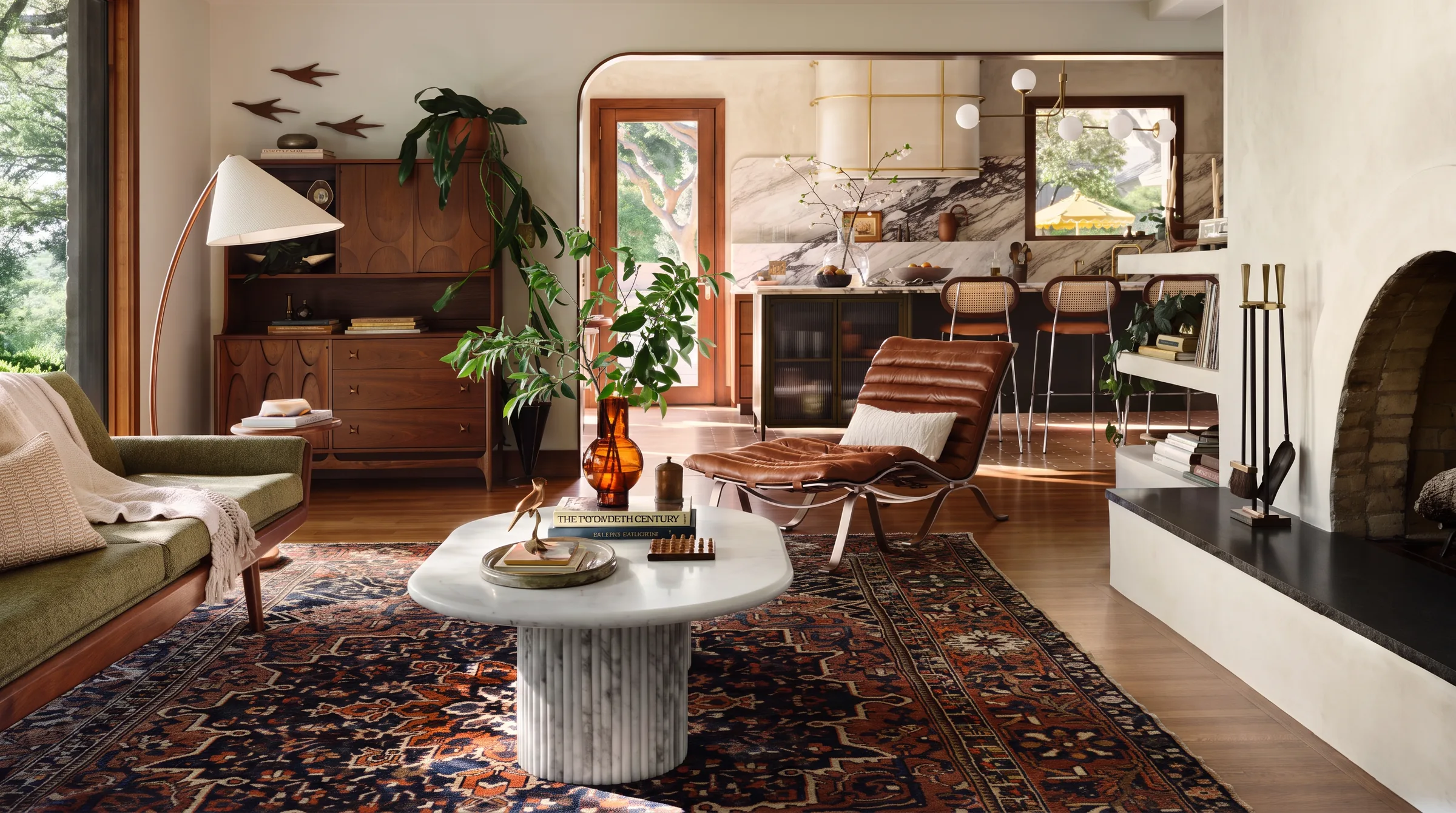
Mid-century modern is a design movement, not a date stamp. A chair made in 1955 only counts if it follows the movement's rules: clean lines, honest materials, almost no applied ornament and legs that lift everything clear of the floor. Get those rules right and the style works in a new Tirana flat as well as it worked in a 1950s house.
Not sure this is your style? Compare it against eleven others in our guide to interior design styles.
Key takeaways
- The style is defined by its principles, not by the decade a piece was made in.
- Low seats, shallow depths and raised legs keep the floor visible and the room reading larger.
- Warm neutrals carry the room. One or two saturated accents do all the colour work.
- Danish modern is a branch of mid-century modern, not another name for it.
- Two or three characteristic pieces are enough. A full matching set reads as a film set.
What mid-century modern actually is
The style came out of the years after the Second World War, mostly in the United States, with a parallel track running through Denmark and Scandinavia. It was a reaction against heavy, ornate pre-war furniture at a moment when homes were getting smaller and new materials were arriving fast.
Sources draw the boundaries differently. Some place it between 1945 and 1969, others stretch it from the early 1930s to the mid 1960s. The label itself was popularised by the writer Cara Greenberg in her 1984 book on 1950s furniture, though the phrase appears in print as early as 1953.
What matters more than the dates is the philosophy. The style removes ornament and gives the job of decoration to the material itself: the grain of the wood, the line of a steel leg, the curve of a moulded shell. Function comes first, and the shape follows from it.
How to recognise mid-century modern
Furniture stands on legs, and the floor stays visible. Tapered and splayed legs, popularised by Paul McCobb, lift the mass off the ground. The floor line runs unbroken under the furniture, which is why a small room reads bigger with mid-century pieces than with skirted or floor-hugging ones.
Everything sits low and horizontal. Sofa backs and storage tops stay below eye level, so sightlines run right across the room. In an open-plan flat where the living area flows into the dining area, this is the difference between one room and two.
Straight lines meet organic curves. A rectilinear credenza next to a moulded shell chair or a kidney-shaped table. That tension is what stops the style from feeling clinical, and it is the part most people skip.
Ornament is almost absent. No carving, no applied moulding, no decorative hardware. The visual interest comes from grain, from a change of material, from a joint you can see.
Negative space is part of the design. Empty wall and empty floor let each piece read as an object. A mid-century room with every corner filled stops being mid-century. That discipline of empty space is the same one that drives modern minimalist interiors.
Furniture is set up to work with the architecture. The style grew up alongside post-and-beam houses with large glazing. Low, leggy furniture preserves the view out and keeps the light moving through.

The mid-century modern colour palette
The base is warm neutral, not grey: putty, oatmeal, warm white, taupe. Cool grey and pastels both fight the style, because the wood tones in the room are warm and the palette needs to sit with them rather than against them.
The middle layer is the wood itself, walnut and teak tones, which do more colour work than people expect. Then come the accents: mustard, burnt orange and terracotta, olive and moss, deep teal. These are saturated but earthy, never bright.
Keep the bulk neutral and allow one strong accent per zone, two at most in a whole room. Designers often pair opposites, teal against warm oak, or blue against orange.
A concrete combination that works: warm putty walls, a walnut credenza, one mustard armchair, and black metal on the lighting to give the room an edge.
There has been a documented shift since 2025 towards a less kitsch reading of the palette, with deeper rust, darker teal and heavier olive replacing the brighter 1950s versions.
Materials and texture
Three materials carry the atmosphere: warm-toned wood, wool or leather, and slim metal.
Wood is the organic core. Walnut and teak give warmth and let the grain act as the pattern in a room that has no other pattern. Wool and leather hold the crisp seat lines that the style depends on, and a tight weave keeps a sofa looking sharp where a loose one would sag into shapelessness.
Metal appears as thin structure, steel or aluminium legs and frames, with brass used sparingly for warmth.
Around those three sit the supporting cast: clear or smoked glass for lightness, ceramic and plaster for a handmade note, rattan and cane for texture, and stone such as terrazzo or travertine to ground a floating room.
One habit worth copying from the period: put natural and man-made next to each other on purpose. Wood beside acrylic, or a wool rug under a moulded plastic shell. That contrast is a signature of the style, not an accident.

Mid-century modern or Scandinavian: how to tell them apart
These two get confused constantly. Danish modern is best understood as a branch of mid-century modern, more sculptural and more craft-based, rather than a separate thing.
Aspect | Mid-century modern | Scandinavian |
|---|---|---|
Mood | Optimistic, experimental, a little eclectic | Calm, restrained, quieter |
Palette | Warm neutrals with bold earthy accents | Lighter overall, softer and more muted |
Materials | Darker woods plus fibreglass, plastic and metal | Mostly natural materials, pale ash, beech and oak |
Lighting | Sculptural and geometric statement fixtures | Soft and diffused, many low-level sources |
Furniture silhouette | Wide range, geometric through to industrial | More consistently organic and sculptural |
Best suited to | Rooms with good light that need warmth and character | Small or dark rooms that need lifting |
If the calmer, paler column is what you actually want, our Scandinavian interior design guide covers how to build it.
How to get the mid-century modern look, step by step
1. Set the layout and the circulation first. Before any piece is chosen, mark the walkways. Leave about 76 cm for any route people take through the room, and about 46 cm between the sofa and the coffee table. Do this today with masking tape on the floor. If the walkways do not survive, the furniture is too deep, and no amount of styling fixes that later.
2. Choose two or three anchor pieces. A low sofa, one sculptural accent chair, and a credenza. These carry the style, so this is where the budget belongs. Everything else is support.
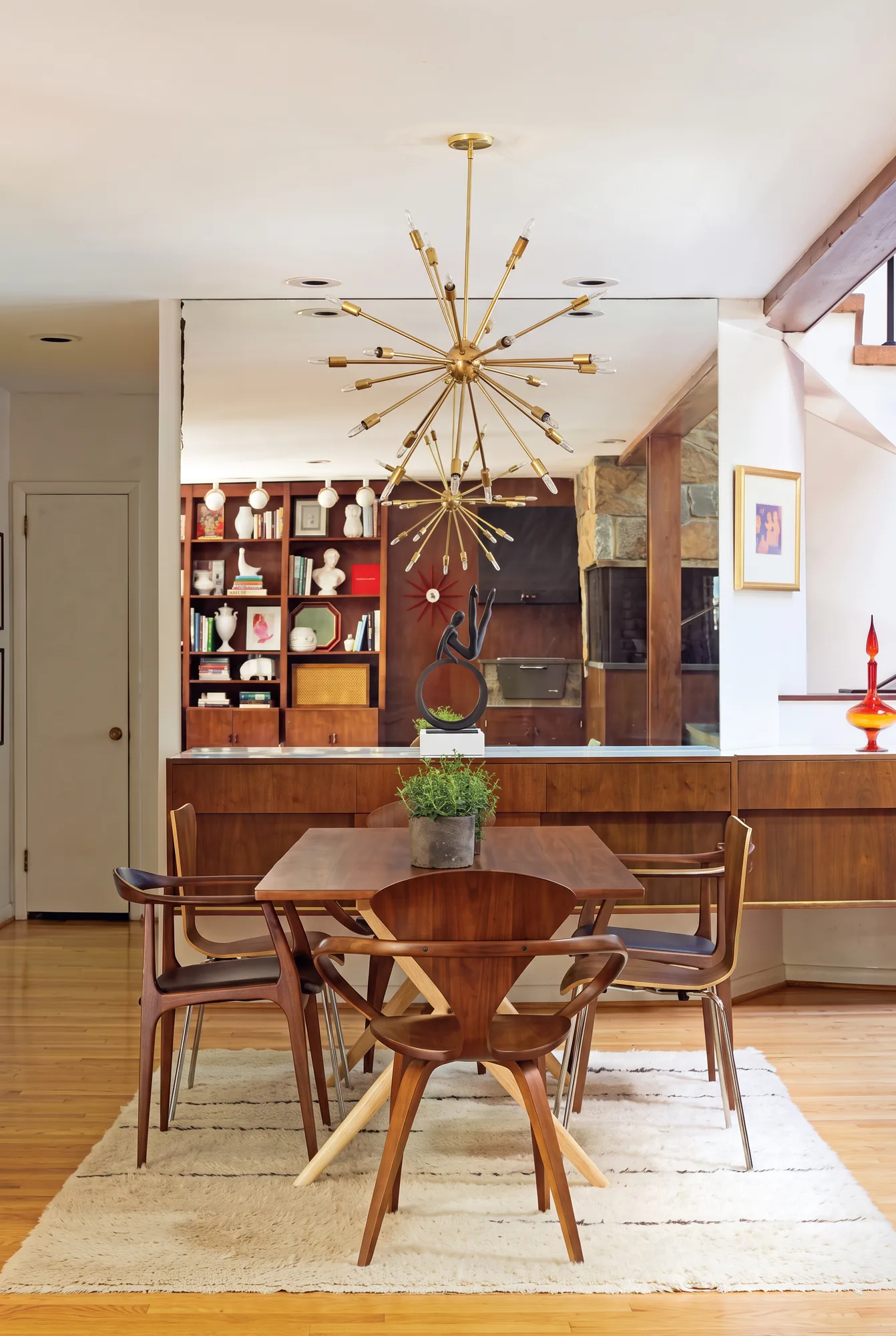
3. Set the shell to warm neutral. Walls in putty or warm white, and stop there. Painting the shell before the furniture arrives is the wrong order, because the wall tone has to sit with the wood tone you have actually bought, not the one you imagined.
4. Layer the texture, and go bigger on the rug than feels right. Wool underfoot, leather or tight-weave upholstery, one or two ceramics. Hard floors alone make a leggy mid-century room feel cold and echoey, because there is less soft mass in the room to absorb it.
5. Treat the lighting as sculpture, and keep the light warm. One statement pendant or floor lamp, with bulbs in the 2700K to 3000K range. Cold white light kills the warmth that the whole palette was built for.
6. Style last, and leave the gaps. A few objects, plenty of empty surface. Then stop and live with it. The strongest mid-century rooms are collected over years, not bought in an afternoon.
The measurements worth getting right
- Sofa seat height: 40 to 46 cm, lower than the current standard of 43 to 48 cm
- Sofa seat depth: 51 to 58 cm, against 66 cm or more on a contemporary lounge sofa
- Sofa back height: 71 to 81 cm, deliberately low to keep sightlines open
- Coffee table height: 40 to 46 cm, level with the sofa cushion or 2.5 to 5 cm below it
- Dining table height: 71 to 76 cm, with chair seats at 46 to 51 cm
- Rug placement: front sofa legs 20 to 30 cm onto the rug, and under a dining table the rug should extend at least 61 cm past the edge on every side
- Pendant over a dining table: 76 to 91 cm above the tabletop
That seat depth line is the single most useful number here. Mid-century seating is shallower and lower than almost anything sold as a lounge sofa today, and that is what keeps a narrow room walkable.
In a living room 3.2 m wide, a 70 cm deep catalogue sofa plus a coffee table leaves a walkway too tight to use properly, and the room starts to feel smaller than it is. A sofa built at 55 cm deep gives back the circulation without giving up the seat. If your room is fighting standard depths, send us your measurements for a quote.
How to do this in a modern home without it looking like a showroom
Most readers are not restoring a 1950s house, and they should not try to. Two or three characteristic pieces are genuinely enough. A credenza, a chair with a recognisable silhouette, and the right seat proportions will carry a room that is otherwise contemporary.
Keep three things authentic: the proportions, the honest materials, and one real anchor piece if you can find or commission it. Everything else can be current. Upholstery fabrics, lighting, art, the television, the rug, all of it can be from this decade without breaking the look.
Mixing eras is what saves the room. A vintage-profile credenza under contemporary art, or a leather lounge chair next to a modern sofa, reads as a home. A room where every item is from the same catalogue reads as a set. The same logic makes Art Deco a good neighbour: both styles are built on clean line and visible proportion.

The set designer Amy Wells, who dressed the interiors on Mad Men, described the goal as imperfect rather than iconic. That is a good test. If the room looks like it was assembled in one go, it needs something in it that does not match.
What usually goes wrong
Buying the whole look at once. This is the most common failure and the easiest to avoid. Rooms bought in one purchase look like showrooms, because they are.
One wood tone everywhere. Dark floors, dark credenza, dark dining table and the room goes flat. Mix the tones deliberately. The period did.
Cold white light. People spend months on the palette and then fit 4000K bulbs, which drains the warmth straight out of it. Warm bulbs are cheap and they fix more than most furniture purchases.
Too many accents, or no rug at all. Three or four strong colours competing is chaos, not character. And a room of legs standing on bare tiles has nothing soft in it. One large wool rug does more than three small ones.
For hotels, cafes and offices
At commercial scale the style holds up well, which is why it keeps appearing in hotel lobbies, offices and cafes: open plans, natural materials, sculptural lighting and warm wood against a neutral shell.
What changes is everything around the look. Seat comfort has to work over hours rather than minutes, so the low mid-century seat height needs testing with the actual user in mind. Circulation has to survive full occupancy, not just a photograph. And finishes and quantities have to repeat exactly across a fit-out, which is where vintage sourcing stops being practical and made-to-order takes over.
Frequently asked questions
What years is mid-century modern?
There is no agreed answer. Common ranges are 1945 to 1969 and roughly 1933 to the mid 1960s, and credible sources genuinely disagree. Treat it as a movement with soft edges rather than a fixed period, because the design principles matter more than the boundary dates.
What is the difference between mid-century and mid-century modern?
Mid-century is a time period. Mid-century modern is a style. Plenty of furniture made in the 1950s was ornate and traditional, and none of it is mid-century modern. If a piece has carving, applied moulding or heavy skirting, the date does not save it.
Is mid-century modern out of style?
No, but its usage is shifting. Designers report using it in a more restrained way, with deeper and less kitsch colours, and mixed with contemporary pieces rather than used as a complete period look. If that quieter direction appeals, our guide to Japandi style shows the far end of it.
What colours are mid-century modern?
Warm neutrals as the base, putty, oatmeal, warm white and taupe, with walnut and teak wood tones in the middle. Accents come from a small earthy set: mustard, burnt orange, olive and deep teal, used one or two at a time.
Start with the room, not the furniture
Mid-century modern is not hard to get right, but it is easy to get slightly wrong, and the errors are almost always dimensional: a sofa too deep, a coffee table too tall, a rug too small. Those are fixable before anything is built.
Send us the room measurements or a few photos and tell us the piece you have in mind, and we will build it to those centimetres. You can also come to the workshop in Tirana and sit on the seat heights before deciding. Thirty years of building furniture to size means we have solved most awkward-room problems at least once already.
Request a quote for your room and we will come back with a price and the exact centimetres, before anything gets built.
You can also browse finished work from the workshop to see these proportions on real pieces.