Modern Mediterranean Interior Design: A Practical Guide
Modern Mediterranean interior design is a warm, pared-back style built on plaster, stone and earth tones. It is not blue-and-white beach decor, and it is not the heavy Tuscan look of dark wood, granite and ornate iron. It draws on Spain, Greece, Italy, Morocco and southern France, then strips out the ornament.
Not sure this is your style? Compare it against eleven others in our guide to interior design styles.
Key takeaways
- The style is architectural first. Surfaces and light do more work than furniture.
- The palette is a chalky neutral base with two or three earth accents, not a rainbow.
- Seating sits lower and deeper than mainstream furniture, which changes how a room feels.
- Reduction beats accumulation. One arch and one plaster wall read better than ten souvenirs.
What modern Mediterranean design actually is
The look began as climate-driven building across Spain, Italy, Greece, southern France and North Africa: thick walls, shaded courtyards, small openings, whitewash. Those were practical answers to heat and glare, and they produced deep reveals and soft light. The name got attached to a second thing in the 1920s and 1930s, when Mediterranean Revival peaked in Florida and California under architects like Addison Mizner and Bertram Goodhue. Sources draw the boundary differently, some dating the style to the vernacular, some to the Revival, some to its streamlined 2010s reinterpretation.
What makes the modern version modern is subtraction. It keeps the plaster, the stone, the terracotta and the arch, and drops the vibrant primary hues and the fussy detail. Designers describe it as the relaxed cousin of traditional Mediterranean: reduction rather than accumulation, with raw materials carrying the room.
How to recognise modern Mediterranean design
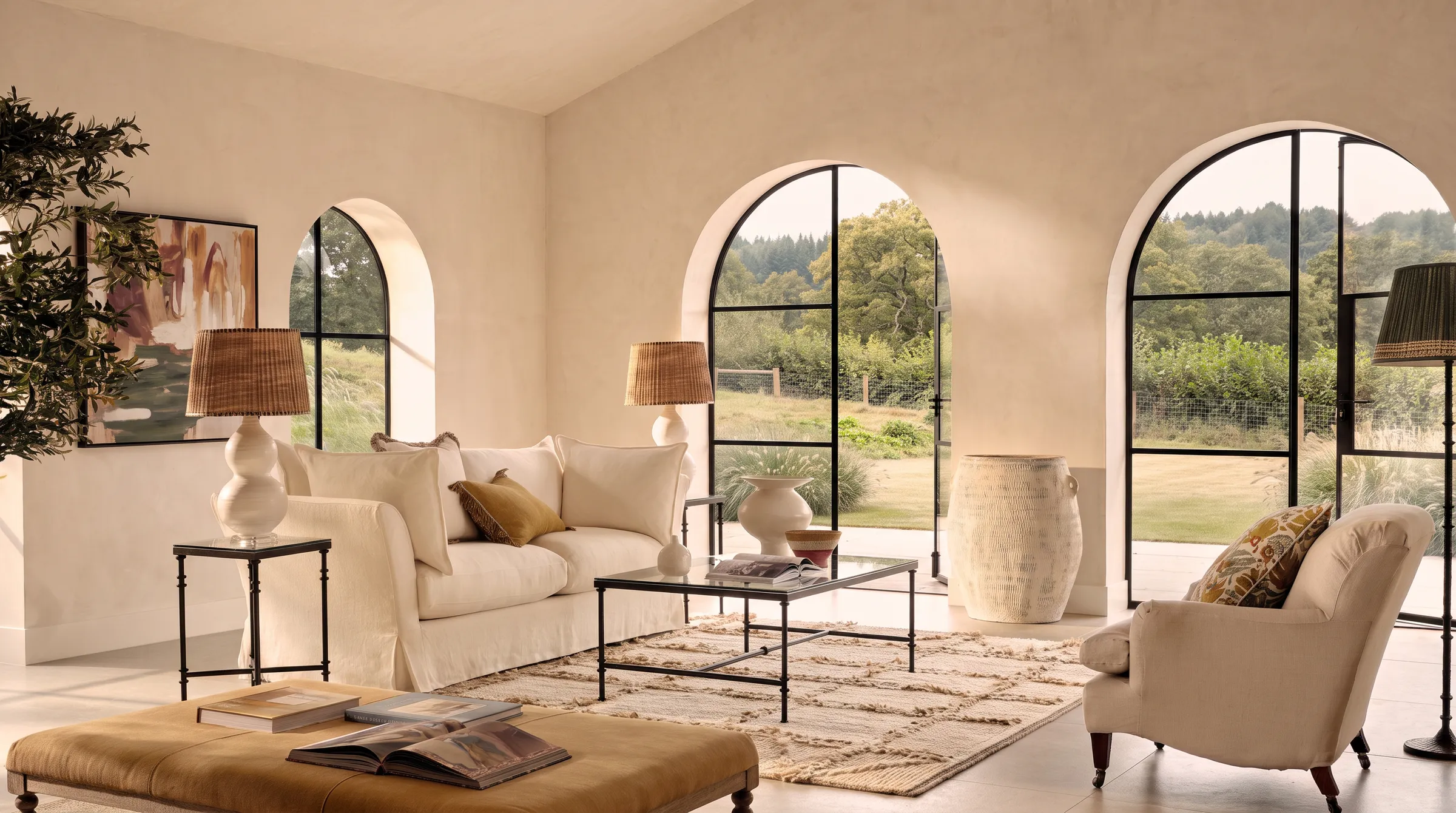
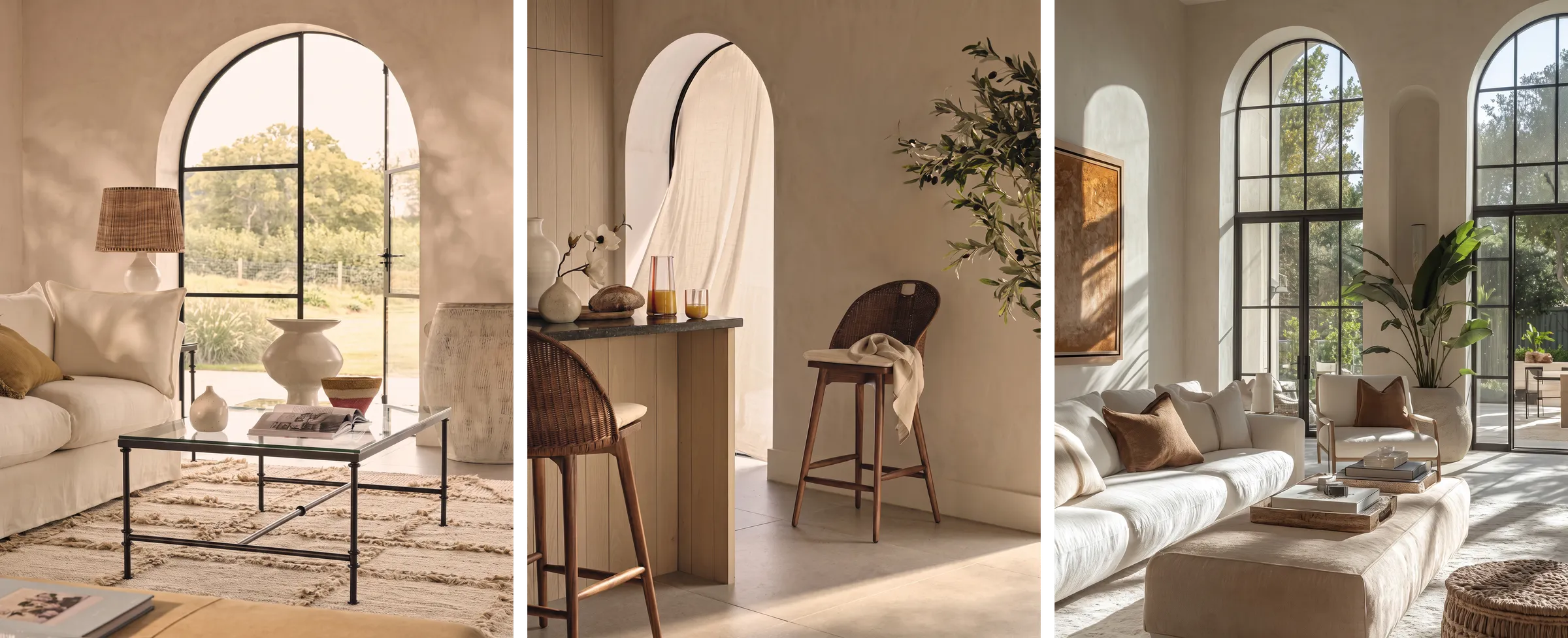
Arches and curved plaster reveals. An arched opening slows the eye at the point where one room becomes another. It marks a boundary without closing it, so a small flat still reads as connected.
Hand-troweled plaster or limewash walls. Flat paint gives you one value all day. Textured plaster catches light at an angle and shifts from morning to evening, which is why a plain room in this style never looks empty.
Exposed beams. Wood overhead pulls the ceiling into the composition and adds warmth above eye level, where most rooms have nothing.
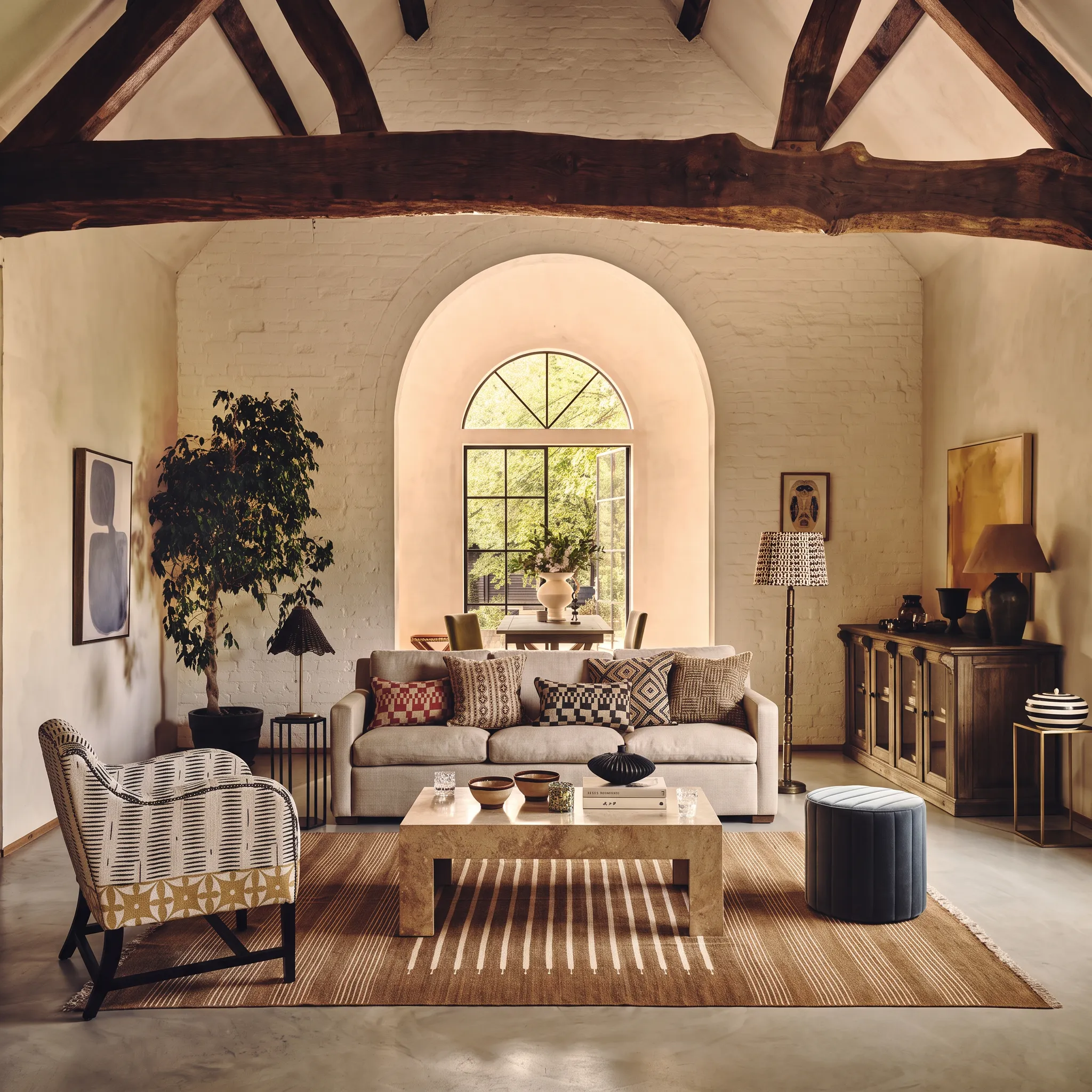
Deep reveals and generous thresholds. Thick walls and recessed windows frame the view like a picture. Large glazed doors do the opposite job, pulling the outside in. Both are about the relationship between the room and the light.
Built-in seating and wall niches. When a bench or banco is part of the wall, the furniture stops competing with the architecture. Recessed niches hold ceramics and give a flat wall depth without hanging anything on it.
Negative space. Empty floor and empty wall are part of the design, not gaps waiting to be filled. Curves replace sharp corners, so the room feels softer even when it is nearly bare.
The colour palette
Start with a warm neutral base: chalky whites, off-whites, oat, sand. Pure white is doing this style no favours, since it can read stark and clinical against natural materials. Softer whites keep the warmth.
Accents come from landscape, not from a colour wheel: olive and sage green, terracotta and clay, ochre, deep sea blue, muted red. Keep them few. Two or three accents against a neutral base is the norm, and the modern version often adds black or charcoal window frames for contrast.
A combination that works: oat walls, olive-green linen curtains, a terracotta pot, one deep-blue ceramic and natural oak underfoot. Note that traditional and regional sources happily use saturated accents while contemporary designers push desaturated chalky palettes, so how bold you go is a real choice, not a rule.
Materials and texture
Three materials carry this style: plaster, stone and linen. Lime plaster and limewash give walls a soft matte surface with cloudy tonal movement. Pale limestone and travertine ground a room and hold the sun-bleached calm, whether as flooring or as a low table. Washed linen brings the slight imperfection that stops the room looking manufactured.
Everything else is an accent. Terracotta floors and pots warm the base. Handmade glazed tile brings small variations of sheen that flat tile cannot. Wrought iron and aged brass read dark and warm against light walls. Rattan and rush add an open weave. Leather ages into the room. Handmade ceramics on an open shelf do the last ten percent.
The rule underneath all of it: natural materials over synthetic ones. Texture is what makes an earthy palette look intentional rather than beige.
Modern Mediterranean, coastal and Tuscan compared
Modern Mediterranean | Coastal | Tuscan or old world | |
|---|---|---|---|
Mood | Warm, calm, sun-bleached | Cool and breezy | Dim, cosy, heavy |
Palette | Chalky white, sand, olive, clay | White, pastel, blue | Gold, deep terracotta, brown |
Materials | Plaster, stone, terracotta, linen | Painted wood, cotton, glass | Dark wood, granite, ornate iron |
Lighting | Soft daylight, warm woven fixtures | Bright and even, open plan | Low and warm, fewer openings |
Silhouette | Low, generous, softened edges | Lighter, more upright | Bulky, carved, ornamented |
Best suited to | Rooms with decent daylight | Bright open-plan homes | Large period rooms |
How to get the look, step by step
1. Fix circulation before anything else. Walk the route you take from door to sofa to balcony and keep it clear at 90 cm minimum. This style rewards empty floor, so decide where the emptiness goes first.
2. Set the palette. Designers on this style begin here. Choose one warm neutral for walls, one wood tone, and no more than three accents. Write them down before you buy anything.
3. Do the surfaces. Plaster or limewash walls, an arched opening if the layout allows, floors in stone, terracotta or warm wood. Surfaces come before furniture because they set the light.
4. Anchor with large natural pieces. A neutral linen sofa, a travertine or solid wood table, a wool or jute rug. Three large calm objects, not eight medium ones.
5. Light it warm and low. Woven or iron fixtures, warm bulbs, several small sources rather than one ceiling light. Hang dining pendants 75 to 90 cm above the tabletop.
6. Style last, and lightly. Handmade ceramics, a few baskets, one olive or fig in a terracotta pot. One good hand-painted platter beats ten small objects.
The measurements worth getting right
- Lounge seating: this style runs low and deep. Seat height around 34 to 43 cm against a mainstream 43 to 48 cm, seat depth 60 to 75 cm against a standard 51 to 61 cm. That is the single change that makes a room feel Mediterranean rather than generic.
- Coffee table: level with the sofa cushion or 2.5 to 5 cm below it. With a low sofa that means roughly 35 to 41 cm, and 25 to 35 cm for the lowest layouts. Leave 35 to 45 cm between sofa and table.
- Dining: table height 71 to 76 cm, with 76 cm the most common. Allow 91 cm minimum from table edge to wall, 107 to 122 cm to be comfortable.
- Built-in banco: seat height 43 to 48 cm, depth 46 to 50 cm, backrest reclined 7 to 10 degrees. A lounge banco goes deeper at 56 to 61 cm with bolsters. Keep 25 to 30 cm between seat and table.
- Walkways: 90 cm minimum, 107 cm comfortable, 120 cm between zones in an open plan.
- Rugs: extend 30 to 45 cm beyond the furniture, or 60 cm beyond the table edge under a dining table.
A 60 cm deep sofa is a problem in most Tirana apartments, where the living room is narrower than the catalogue assumes and a balcony door eats one wall. If you want the low, deep seat without losing the walkway, the piece has to be built to your dimensions rather than bought at the nearest standard size.
Built to your walls, not to a catalogue. Send us your room measurements for a free quote and we will draw the sofa or the banco to the centimetre before anything is cut.
How to do this in a modern home without it looking like a showroom
You do not need a villa. One or two characteristic moves are enough: a limewash wall, a single arched opening, or simply a linen sofa with a travertine table. Beyond that, restraint does the work.
Keep the materials authentic. Real plaster, real stone, real terracotta, real linen. Faux-aged finishes and plastic that pretends to be fibre are exactly what makes a room read as a set.
Let the rest be contemporary. Clean-lined furniture, minimal hardware, a modern kitchen, dark window frames for contrast. If you rent, limewash-look paint with the landlord's agreement, washed linen textiles, an oversized woven pendant, rattan and terracotta pots will carry the style without touching the structure.
What usually goes wrong
Theming it. Blue-and-white tile everywhere, iron scrollwork, plastic vines. That is a themed restaurant, not a home. Blue and white is one regional palette, not the whole style.
Faking the age. Sponged and rag-rolled walls meant to look old look painted. Real lime finishes patinate on their own, which is the entire point of using them.
Substituting synthetics. A synthetic rug and faux wood undo the warmth faster than any colour mistake.
Overfilling the room. Matching accessory sets bought in one go read as a purchase. Negative space is a feature here, and empty wall is allowed.
For hotels, cafes and offices
The style suits hospitality because it slows people down. Plaster, terracotta and warm light make a room people linger in, which is the whole business model of a cafe or a hotel bar.
At scale, three things change. The material palette has to survive traffic, so the plaster, stone and fabric specification gets harder even where the look stays soft. Circulation gets defined rather than casual. And built-in banquettes do double duty, giving you the communal feel and better covers per square metre. For reference, banquette tables sit 31 to 36 cm apart at minimum, or 61 cm apart when you want privacy, with seats around 48 cm high and 46 to 51 cm deep.
Frequently asked questions
Is Mediterranean the same as coastal?
No, though some sources treat Mediterranean as a coastal sub-family. Coastal is cool, breezy and pastel with nautical references. Mediterranean is warmer and more tactile, built on earth tones, plaster and stone, with more defined rooms and more visual weight.
What is the difference between Mediterranean and Tuscan decorating?
Tuscan is one region of Italy, and it runs heavier: dark wood, granite, ornate iron, gold and deep terracotta. Mediterranean pulls from several cultures and is lighter and airier, with cleaner-lined furniture and a chalkier palette.
Can I do modern Mediterranean in a small apartment?
Yes. Textured walls, one arched detail if the layout allows, warm neutral large pieces with clean lines, and natural textiles. Keep the walkway at 90 cm and choose fewer, larger objects. Small rooms suffer most from clutter, and this style is built on restraint.
How do you make a Mediterranean room feel modern and not dated?
Drop the ornament and keep the materials. Streamlined furniture, minimal hardware, dark window frames, and no faux-aged finishes. The dated versions are dated because of decoration, not because of plaster and stone.
Get the proportions right in your own room
The hardest part of this style is not the palette, it is the fit: a sofa deep enough to feel right in a room narrow enough to make that difficult, or a banco that has to work around a radiator and a balcony door.
Formo has been building custom furniture in Tirana for over 30 years, for apartments and for hotels, cafes and offices. We work from your measurements, in the wood and the finish you choose.
Send us your wall measurements and a few photos for a free quote, or come by the workshop and we will work out what the room can actually take.
You can also browse finished work from the workshop, where the plaster, stone and linen in this guide show up in real rooms.