Modern Farmhouse Interior Design: Features, Colors, Materials
Modern farmhouse is a transitional style: clean contemporary lines warmed by rough, natural texture. It is not shiplap, barn doors and white paint everywhere. That formula belongs to one television era, and it is the part that dates fastest. What lasts underneath is the proportion, the texture and the restraint.
Not sure this is your style? Compare it against eleven others in our guide to interior design styles.
Key takeaways
- Modern farmhouse is clean lines plus rustic texture, not a set of decorative props.
- Texture does the work that colour usually does. The palette stays narrow so the materials can speak.
- Black is structural, not decorative. It draws the lines that soft neutrals cannot.
- Scale runs generous: longer tables, deeper seating, larger light fixtures.
- Two or three characteristic pieces are enough. More than that reads as a theme.
What modern farmhouse actually is
Farmhouses were working buildings long before they were a style. The form travelled from Germany and Scandinavia and reached the United States in the 1700s, and American farmhouses through the late nineteenth and early twentieth centuries were built for function rather than appearance. Plain surfaces, sturdy furniture, tables long enough to feed everyone working the land.
The named style is far newer. It took shape in the 2010s and spread widely through the Fixer Upper years, roughly 2013 to 2018. What it removes is ornament, gloss and hard edges. What it keeps is the plainness of the old building: visible wood, matte surfaces, furniture built to be used rather than admired. It answers one problem well, which is how to make a contemporary open plan feel warm instead of clinical.
How to recognise it
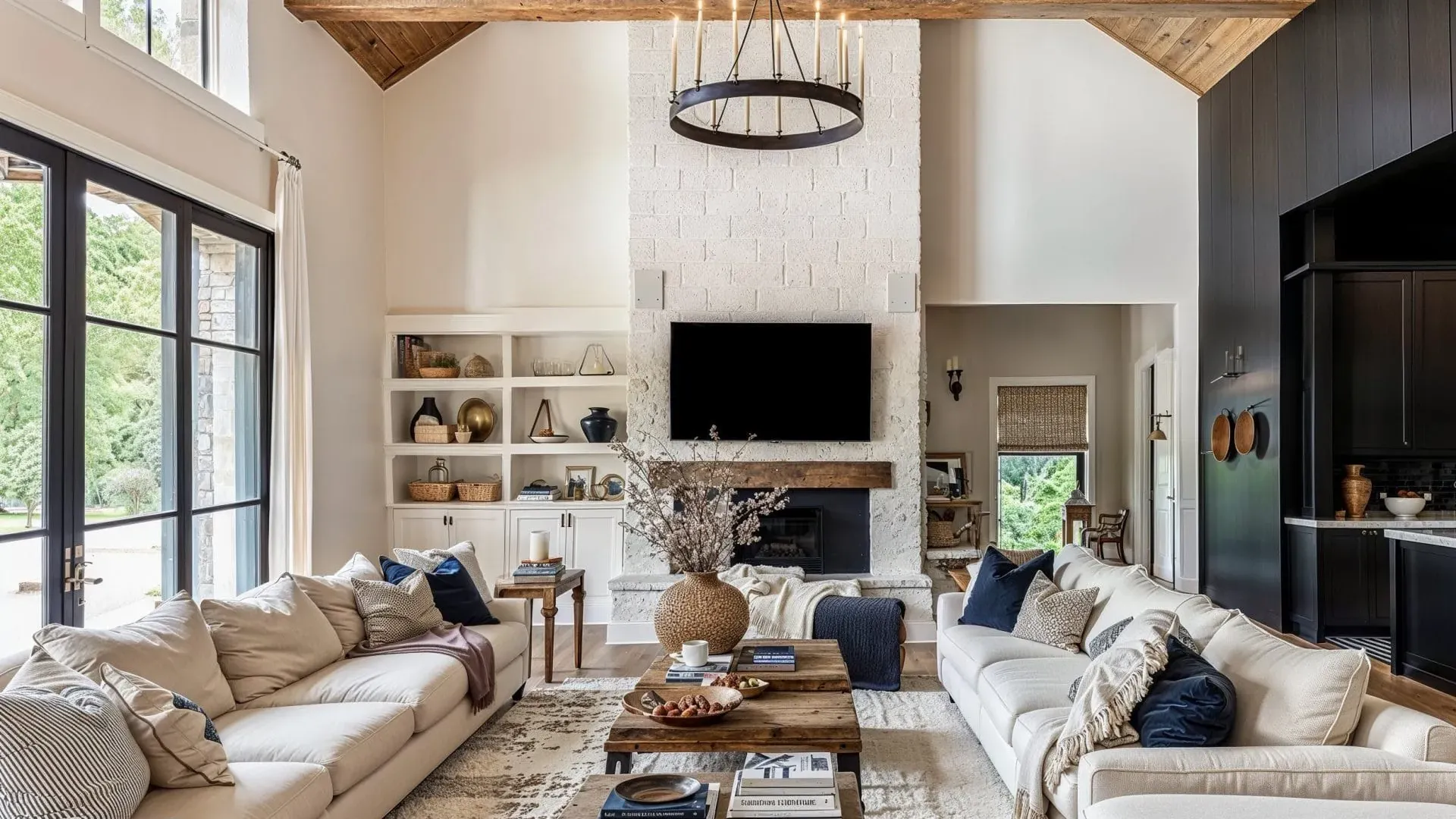
Simple silhouettes against rough texture. A straight-lined sofa next to a weathered wood table. Neither element is doing much on its own. The contrast between the smooth and the coarse is what makes the room read as farmhouse rather than plain modern.
Black used structurally. Black window frames, matte black hardware, one black light fixture. Black defines lines and frames views. Without it, a room of warm whites and greys goes flat and loses its edges.
Wood overhead and underfoot. Exposed beams pull the eye up and give a high open-plan ceiling something to hold onto. Wide floorboards do the same at ground level. Together they warm the two surfaces you never upholster.
Generous scale. Major pieces run larger than mainstream contemporary furniture. A longer table, a deeper sofa, an oversized pendant. The effect is grounded and settled rather than delicate.
Texture instead of colour variety. Five textures in two colours will always beat five colours in one flat finish. Texture supplies visual weight without visual noise.
Daylight treated as a material. Large windows and unfussy window treatments. Heavy drapery works against the whole idea.
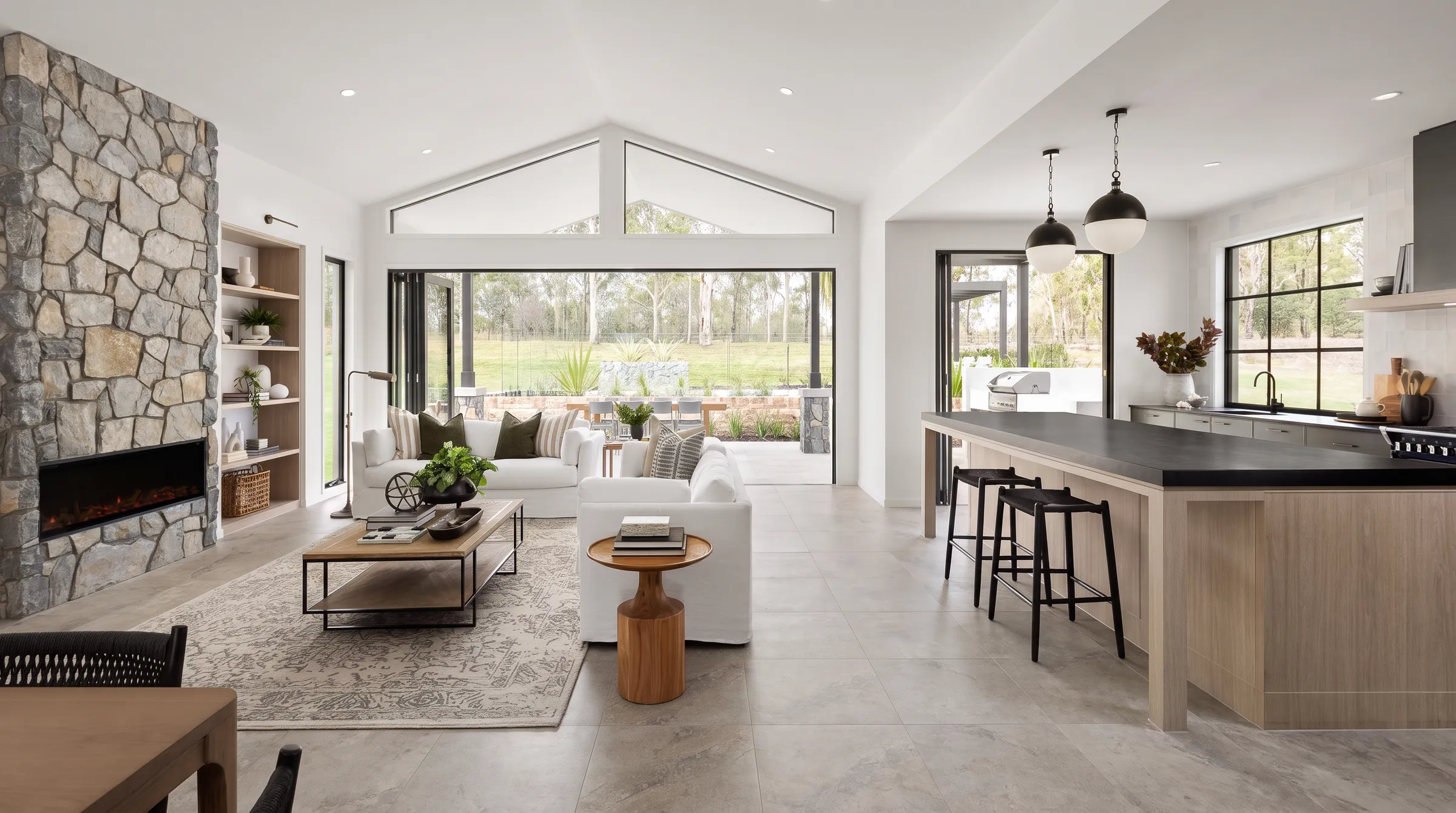
The colour palette
The structure is consistent. A warm white or cream base on the walls. A soft greige or putty as the second neutral, usually on lower cabinetry or joinery. Natural wood as the warmth. Black as the anchor.
Strong colours are used sparingly, often just one muted green or blue across an entire room. The discipline is the point: with a narrow palette, the linen, the stone and the wood grain become the visual interest.
A concrete combination that works: warm white upper walls, a putty grey on lower cabinetry, a natural wood tabletop, and soft black on trim and fixtures.
There is a documented shift here worth knowing about. Designers have been moving away from stark white and cool grey toward warmer, earthier neutrals for 2025 and 2026: camel, clay, mushroom, olive, terracotta. Sherwin-Williams named a warm grounded khaki as its 2026 colour of the year, and its colour team describes green-leaning beiges, soft greiges and putty tones as gaining ground because they hold the versatility of grey with more warmth. Grey floors in particular have fallen out of favour for reading unnatural.
Materials and texture
Three materials carry this style: wood, plaster and blackened metal.
Wood is the backbone and the reason the room feels organic. Genuinely reclaimed timber brings character that new material cannot fake, but plainly finished new wood reads perfectly modern farmhouse when the silhouette is simple.
Plaster is the quieter development. Warm, slightly irregular, tactile under raking light, it has largely taken over the role shiplap used to play on walls, and it dates far more slowly.
Black metal supplies the structure: lighting, handles, brackets, rails.
Around those three, everything else is texture. Linen and wool soften the palette and add movement. Jute or sisal grounds the floor. Aged leather cools the warm neutrals. Rattan and woven fibre keep things light. Honed stone and handmade ceramic add weight and irregularity. A glazed tile or a run of glass gives the clean modern counterpoint. The working rule is at least three distinct textures per room, the same layering habit that carries a Scandinavian room.
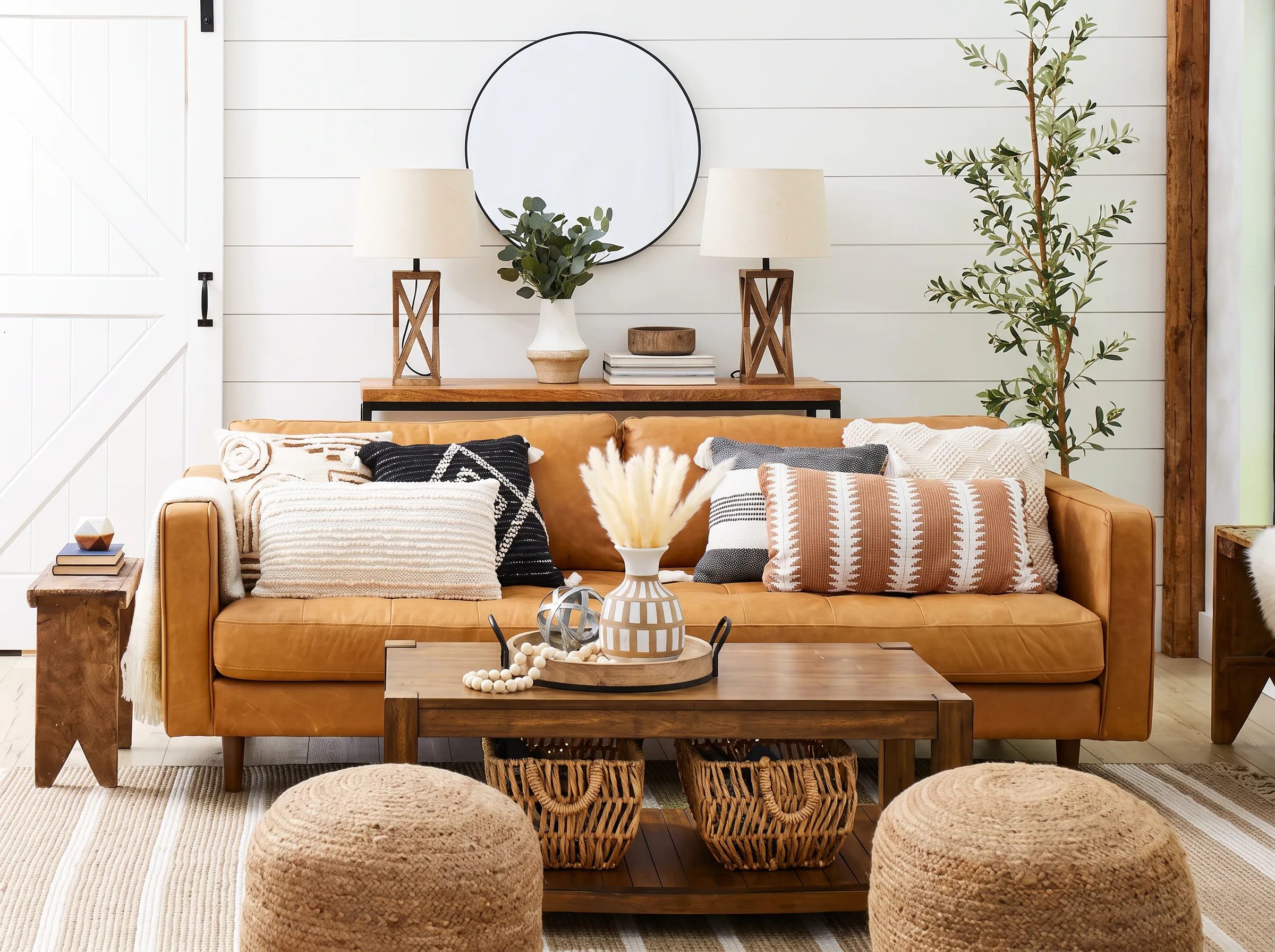
Modern farmhouse compared to the styles it gets confused with
Three versions of the same idea sit close enough together to be confused daily. Traditional farmhouse is the older, denser one. Industrial farmhouse runs the same warmth through industrial modern materials, steel and blackened metal in place of painted wood.
Modern farmhouse | Traditional farmhouse | Industrial farmhouse | |
|---|---|---|---|
Mood | Bright, calm, comfortably plain | Warmer, denser, more collected | Darker, harder, more graphic |
Palette | Warm whites, greige, black accents | Deeper earth tones throughout | Greys, rust, blackened metal |
Materials | Smooth painted surfaces, light wood, engineered stone | Aged wood, brick, plaster | Steel, exposed brick, raw concrete |
Lighting | Vintage reference, clean shapes | Aged, handcrafted, softly lit | Exposed bulbs, sculptural metal |
Furniture silhouette | Streamlined but substantial | Turned legs, distressed finishes | Wood tops on steel frames |
Best suited to | Apartments and open-plan homes | Older houses with existing character | High-ceilinged or converted spaces |
How to get the look, step by step
1. Fix the circulation before you buy anything. Walk the room and mark the routes people actually take. Keep 91 cm clear on every main path. If a route drops below that, the furniture is too big or in the wrong place, and no amount of styling will fix it.
2. Choose the anchor pieces next. In a dining space that is the table. In a living room it is the sofa. These set the scale for everything after them, and modern farmhouse runs generous, so buy the largest piece the circulation allows rather than the largest piece you like.
3. Set the palette before the accessories. Warm white walls, one second neutral, natural wood. Decide the black now too, because it is easier to specify black frames and handles at the start than to swap them later.
4. Layer the texture. Three minimum. Linen curtains, a jute rug and a wool throw is enough to lift a room that already has wood in it. Mix light and medium wood tones instead of matching everything to one finish.
5. Do the lighting properly. One black fixture, larger than feels safe. Hang pendants 76 to 91 cm above the surface they light, and keep at least 210 cm of floor clearance underneath so nobody walks into them.
6. Style last, and slowly. Leave gaps on the shelves. A room that looks collected over years never arrives in one delivery.
The measurements worth getting right. These are the numbers we come back to on almost every farmhouse table and bench we build.
- Dining table height: 76 cm. Farmhouse tables are the same height as any other, just longer and heavier.
- Table length by seats: 180 cm seats six to eight, 210 cm seats eight, 240 cm seats ten.
- Bench seat height: 43 to 51 cm, which is roughly 25 to 30 cm below the tabletop.
- Bench depth: 38 to 51 cm, with about 45 cm the comfortable middle.
- Sofa seat depth: 53 to 61 cm standard, 61 to 71 cm for the deeper lounge feel this style prefers.
- Clearance behind a bench: 91 cm to walk past, 120 cm to pull the bench fully clear of the table.
Those last two numbers are where most Tirana dining areas fall apart. A 240 cm table needs a room that can also give up 120 cm behind it, and in a flat with a balcony door on one side and a radiator on the other, that space simply does not exist. The usual fix is a table built to the actual clear length of the wall, with a bench that tucks fully under it on the tight side.
Send us the wall measurements and we will come back with a table length that seats everyone and still lets people walk past. Ask for a quote.
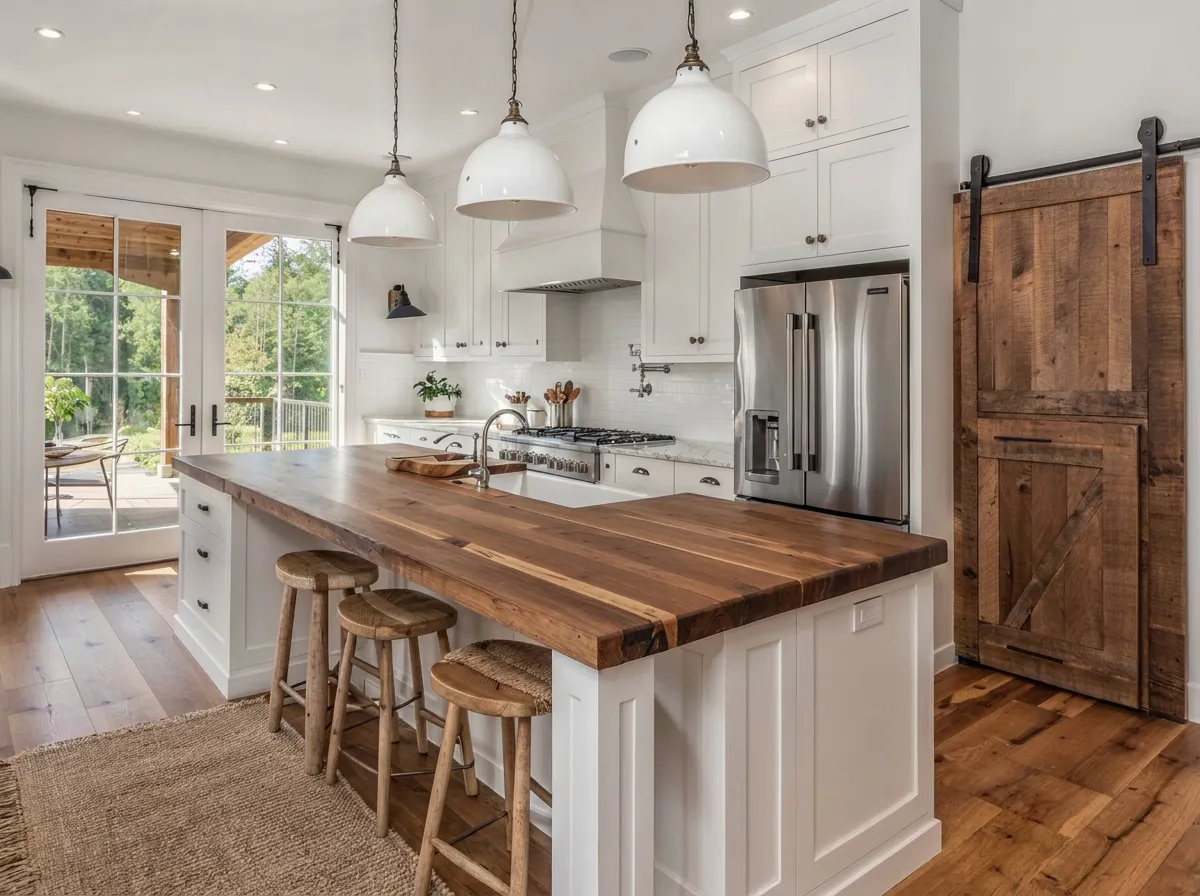
How to do this in a modern home without it looking like a showroom
Count your literal farmhouse signals and stop at two or three. Shiplap, a barn door, buffalo check, mason jars, word art: any one of them can work, but stacked together in one room they stop reading as a style and start reading as a set.
Keep the material honest and let the styling be changeable. Real wood, real stone and quality upholstery age well. Factory distressing does not, and it is the single fastest way to date a room. Put the trend into pillows, curtains and paint, which cost little to change, rather than into fixed elements like black window frames.
Everything else can be contemporary. Modern seating silhouettes, mixed metals, current art in plain wood frames. Mixing eras is what saves the look: mid-century chairs around a heavy plank table, or tailored upholstery instead of slouchy slipcovers, and the room reads as yours rather than as a catalogue page.
In an apartment with no beams and no barn to reference, the whole style comes down to three moves. One wood anchor, layered texture, one black light fixture.
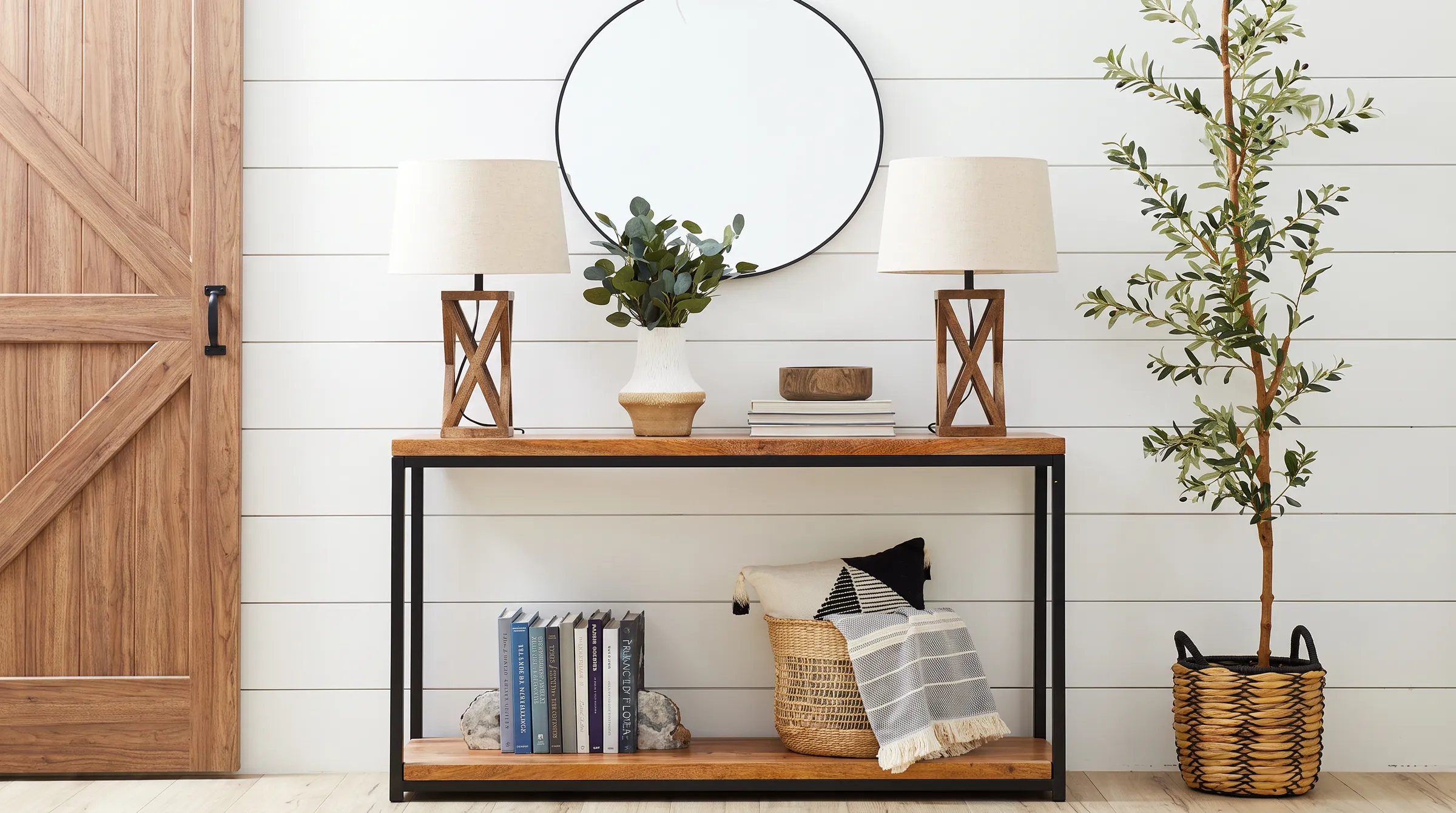
What usually goes wrong
The theme takes over. Roosters, Gather signs, mason jars used as objects rather than jars. Think about the essence of a farmhouse, which is plainness and function, not the literal props.
One element gets repeated until it is noise. Shiplap on every wall, a barn door where a normal door was fine, matte black on every handle in the flat. Repetition stops being a decision and starts looking like a builder's default.
Nothing has room to breathe. Shelves crammed edge to edge, every surface styled. Negative space is a material in this style. The eye needs somewhere to rest, and clutter is what makes a warm room feel small.
The whole set arrives at once. Matching table, chairs, sideboard and mirror from one collection kills the collected-over-time quality the style depends on. Buy the anchor pieces properly and let the rest accumulate.
For hotels, cafes and offices
Modern farmhouse partly came out of hospitality, so it holds up well at scale. Restaurants adopted the look early, and the elements that made it work there still apply.
Three things change commercially. Materials need to take a patina rather than resist it, because worn wood, stone and steel look better after two years of traffic while thin veneers and painted MDF edges do not. Seating density matters, and long communal tables with benches seat noticeably more people per metre than individual chairs. And repeatability becomes the real constraint: twenty chairs in a matching finish, delivered on one date, with the option to build ten more in the same tone in eighteen months.
Frequently asked questions
Is modern farmhouse out of style?
The formulaic version is fading and the warmer version is not. A 2025 survey of 154 designers across the US and Canada found the large majority expect the all-white shiplap look to pass, while other designers argue farmhouse has settled into permanence. In practice, the props date and the principles do not.
What is the difference between modern farmhouse and traditional farmhouse?
Modern farmhouse is cleaner, brighter and more edited: painted surfaces, lighter woods, contemporary lines. Traditional farmhouse is denser and more textured, with aged wood, brick, richer earth tones, turned legs and eclectic vintage furniture. Same warmth, different amount of visual information.
Can you do modern farmhouse in an apartment?
Yes, and it suits apartments better than most rustic styles. The look does not require beams or a rural building, it requires warm neutrals, layered texture and one wood anchor. A wood table, a jute rug, linen curtains and a black pendant is the whole recipe in a flat.
Do I need shiplap?
No. Shiplap was structural sheathing that sat behind wallpaper or plaster and was never meant to be seen, and much of what gets sold as shiplap is not technically shiplap at all. Warm plaster gives the same tactile wall with none of the association.
Get the room measured properly
Modern farmhouse rewards generous furniture, which is exactly what makes it hard to buy off the shelf in an apartment. The table that seats everyone is 20 cm too long. The sofa with the right depth is 15 cm too wide for the wall.
We have been building furniture in Tirana for over 30 years, in solid wood, veneered MDF and laminate depending on what suits the piece. Send us the wall measurements and a photo of the room, or come to the workshop and see the materials in person.
Request a free quote for your dining table and we will come back with a drawing and a price.
Or look through our gallery first, to see how the wood and the black metal actually sit together in a finished room.